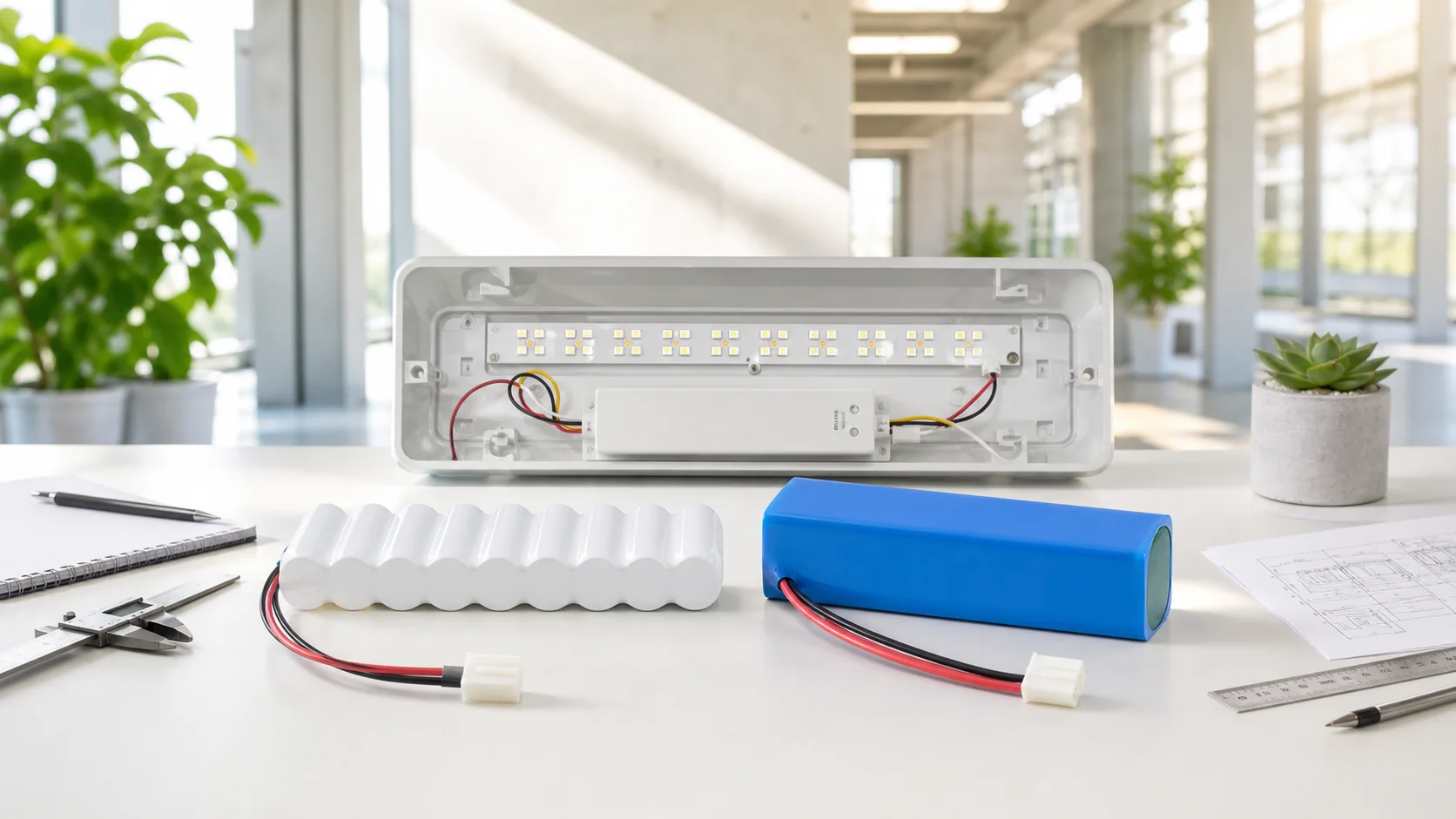
In brief: Choose an emergency-light battery as part of the complete luminaire system. Ni-Cd can suit approved high-temperature and established designs, while lithium systems can reduce pack size and add dedicated protection. Market rules, driver compatibility, temperature, storage, transport evidence and model-specific duration decide the safer purchase.
The direct answer
There is no universally better battery chemistry for emergency lighting. A buyer should approve the complete battery, charger, emergency driver, LED load and luminaire as one tested configuration.
Ni-Cd remains available in established emergency-lighting designs and can be robust at elevated temperatures when the exact cell and control gear are rated for that environment. Lithium systems can provide higher energy density and a smaller pack, but they require chemistry-specific charging, protection and transport evidence. The target market may decide the issue before either technical advantage does.
For an RFQ, choose chemistry only after confirming five items: market eligibility, rated temperature, storage and commissioning conditions, driver and protection compatibility, and the evidence that connects the battery pack to the ordered luminaire.
Li-ion and LiFePO4 are not interchangeable labels
Lithium-ion is a family of rechargeable chemistries. Lithium iron phosphate, normally written LiFePO4 or LFP, is one member of that family. A quotation that says only "lithium battery" is incomplete because cell chemistry, pack voltage, protection circuit, charger, operating temperature and approved driver combination can differ.
Emergency-lighting manufacturer Tridonic documents LiFePO4 packs with pack-level and driver-level protection, while Zhuiming's current catalog uses the broader term Li-ion for its listed models. The catalog wording does not confirm that every Zhuiming lithium pack is LiFePO4. Buyers should request the exact chemistry and battery specification for the model being approved.
Ni-Cd and lithium emergency light batteries compared
| Procurement question | Ni-Cd | Lithium system | |
|---|---|---|---|
| Proven system fit | Used in long-established emergency-lighting control-gear designs | Must be matched to the stated lithium chemistry, charger, protection and driver | |
| Space and energy | Packs are generally larger for a comparable energy requirement in Tridonic's emergency-lighting comparison | Tridonic identifies higher energy density as a LiFePO4 advantage; the actual size still depends on output and duration | |
| Temperature decision | High-temperature Ni-Cd products exist, but use the pack and control-gear temperature ratings | High-temperature LiFePO4 products also exist; pack protection and battery-case temperature limits remain model-specific | |
| Storage and commissioning | Follow the pack maker's storage, recharge and activation instructions | Follow the pack maker's state, connection, temperature and commissioning instructions | |
| Market restriction | Cadmium restrictions can limit use depending on the battery category and destination market | Cadmium is not the issue, but lithium safety, transport and end-of-life requirements still apply | |
| Transport file | Confirm the applicable dangerous-goods classification and supplier documents | Ask for the matching UN 38.3 test summary and current shipment instructions | |
| Field replacement | Replace only with the approved pack or a documented equivalent | Never substitute chemistry or pack architecture without manufacturer approval and system revalidation |
This table is a sourcing map, not a universal performance ranking. Product-specific data can reverse a broad assumption. For example, Tridonic's current Ni-Cd instructions describe storage windows and activation steps for its own packs, while its current LiFePO4 data sheets specify thermal protection and design-life ranges tied to battery-case temperature. Those figures cannot be copied to another supplier's battery.
Six decisions that determine the right battery system
1. Is the battery eligible in the destination market?
Start with the market and the legal category of the exact pack. The current consolidated EU Batteries Regulation defines a portable battery by size, sealing, intended use and other exclusions. Annex I limits cadmium in portable batteries to 0.002% by weight.
That does not justify calling every emergency-light pack a portable battery or declaring a global Ni-Cd ban. Classification can turn on whether the pack is designed specifically for industrial use, and other markets have different rules. For an EU order, have the importer or compliance specialist document the category and the current restriction before approving a Ni-Cd configuration. Do not rely on an older summary of the repealed Batteries Directive.
2. What temperature will the battery actually see?
Ambient room temperature is not always the battery temperature. The battery may sit near an LED board, charger or enclosed gear tray, and the battery-case temperature can control design life.
The useful comparison is therefore not "Ni-Cd handles heat" versus "lithium lasts longer." Ask both suppliers for the permitted ambient range, maximum battery-case temperature, design life at the proposed temperature, thermal positioning instructions and evidence for the complete luminaire. Tridonic's current Ni-Cd battery instructions and LiFePO4 battery data illustrate how strongly storage and design conditions depend on the exact product family.
3. How will products be stored and commissioned?
Emergency luminaires may spend months in a warehouse, container or unfinished building before permanent mains power is available. That period can matter as much as normal operation.
The supplier should state the maximum storage time, storage temperature, required state or recharge interval, whether the pack must be disconnected, initial charge time and any activation cycles. The installation plan should also prevent uncontrolled repeated discharge while site power is intermittent. These are model instructions, not chemistry-wide constants.
4. Does the battery match the charger and emergency driver?
Battery voltage and amp-hours do not prove compatibility. Charging method, cell count, discharge cut-off, protection devices, connectors, thermal sensing, emergency output and firmware or self-test behavior can all be part of the approved combination.
IEC 61347-2-7 covers particular safety requirements for battery-supplied electronic control gear for self-contained emergency lighting. IEC 60598-2-22:2021 covers particular requirements for emergency luminaires and introduced new requirements for lithium batteries in its fifth edition. These standards are useful specification references, but a standard title is not proof that a particular model, battery and driver combination has been evaluated.
Editorial recommendation: treat a chemistry change as a product redesign, not as a purchasing substitution.
5. What transport evidence follows a lithium pack?
The UN Manual of Tests and Criteria, Revision 8 contains subsection 38.3 for lithium cells and batteries. IATA's 2026 lithium-battery guidance says manufacturers and subsequent distributors must make the applicable test summary available for relevant cells, batteries and equipment.
Ask for a test summary that identifies the actual cell or pack model used in the ordered luminaire. UN 38.3 is transport design-type evidence; it is not emergency-luminaire certification and does not by itself prove duration, emergency output or destination-market compliance. Shipment preparation must still follow the current mode-specific, carrier and route requirements.
6. How will the battery be tested, replaced and collected?
Procurement cost should include more than the first battery price. Compare the design life at the intended temperature, duration-test schedule, replacement access, spare-pack identification, approved substitutions, shipping documents, waste-battery registration and collection duties in the destination market.
Do not assign a universal service-life number to either chemistry. The defensible number is the one stated for the exact pack under the proposed temperature, charging and test conditions.
Can Ni-Cd be replaced with a lithium battery?
Not as a like-for-like field swap unless the luminaire manufacturer has approved the complete alternative configuration. A lithium pack with a similar nominal voltage or capacity can still require a different charger, protection circuit, discharge cut-off, connector, thermal arrangement and control-gear setting.
For an existing installed fitting, use the original approved replacement pack or a manufacturer-documented equivalent. For an OEM redesign, repeat the relevant electrical, thermal, duration, abnormal-condition, transport and compliance review for the new battery-driver-luminaire combination.
An emergency-light battery RFQ checklist
Add these lines to the product specification:
- Destination country and intended battery category
- Required luminaire and control-gear standards, editions and evidence
- Exact battery chemistry, cell or pack model, voltage and rated capacity
- Rated emergency duration and emergency output
- Approved battery, charger and emergency-driver combination
- Ambient range, maximum battery-case temperature and expected design life at that temperature
- Storage time, storage temperature, connection state and recharge instructions
- Initial charge, activation and commissioning procedure
- Protection functions, thermal sensing, connector and replacement part number
- Duration-test, recharge and end-of-life acceptance criteria
- For lithium: matching UN 38.3 test summary and shipment documentation
- Destination-market substance, labeling, registration, collection and recycling requirements
Battery capacity belongs in this list, but it cannot replace model-specific duration and output evidence. Use our emergency lighting battery duration guide to complete those RFQ lines.
Zhuiming's confirmed product boundary
Hangzhou Dreamy Technology Co., Ltd. currently lists both Ni-Cd and Li-ion configurations in its product catalog. The L102MN emergency bulkhead is listed with a Ni-Cd pack, while the L130MN emergency bulkhead is listed with a Li-ion pack.
These catalog entries confirm current configuration descriptions, not universal chemistry performance, certification or eligibility for every market. Battery type, capacity, emergency duration and related electrical parameters can be evaluated through the OEM and ODM process. Final chemistry, pack model, driver, output, marking, evidence and compliance scope must be confirmed in the quotation, approved sample and order specification.
Send the destination market, model, quantity, duration, output and battery requirements for a configuration review.
Sources and scope
- IEC: IEC 60598-2-22:2021, emergency luminaires
- IEC: IEC 61347-2-7, battery-supplied emergency-lighting control gear
- EUR-Lex: consolidated Regulation (EU) 2023/1542 on batteries and waste batteries
- UNECE: UN Manual of Tests and Criteria, Revision 8
- IATA: 2026 guidance for lithium and sodium-ion batteries
- Tridonic: main battery types for self-contained emergency lighting
- Tridonic: current Ni-Cd emergency-lighting battery instructions
- Tridonic: current LiFePO4 emergency-lighting battery data
Sources reviewed 30 July 2026. This article provides procurement guidance. It does not replace product engineering, dangerous-goods advice, destination-market legal review, project-specific emergency-lighting design or approval by the responsible authority.
Frequently asked questions
Which is better for emergency lights, Ni-Cd or Li-ion?
Neither chemistry is universally better. Choose the complete approved battery, charger, emergency driver and luminaire system for the destination market, temperature, storage period, required duration, transport route and maintenance plan.
Can I replace a Ni-Cd emergency light battery with lithium?
Not as a like-for-like field replacement unless the luminaire manufacturer approves the complete alternative. Lithium can require different charging, protection, discharge cut-off, thermal controls, connectors and compliance evidence.
Do lithium emergency light batteries need UN 38.3 evidence?
Lithium cell and battery types used in transport pathways generally require the applicable UN 38.3 design-type testing, and manufacturers or distributors must make a matching test summary available. The shipment must also follow current mode, carrier and route requirements.
Are Ni-Cd emergency light batteries allowed in the European Union?
It depends on the legal category and current rules for the exact battery. The EU Batteries Regulation limits cadmium in portable batteries, so the importer or compliance specialist should document whether the emergency-light pack is portable or another category before approval.
What should a battery RFQ for emergency lighting include?
State the destination market, exact chemistry and pack model, approved driver combination, temperature limits, storage and commissioning instructions, rated duration and output, replacement part, required standards, transport evidence and end-of-life obligations.