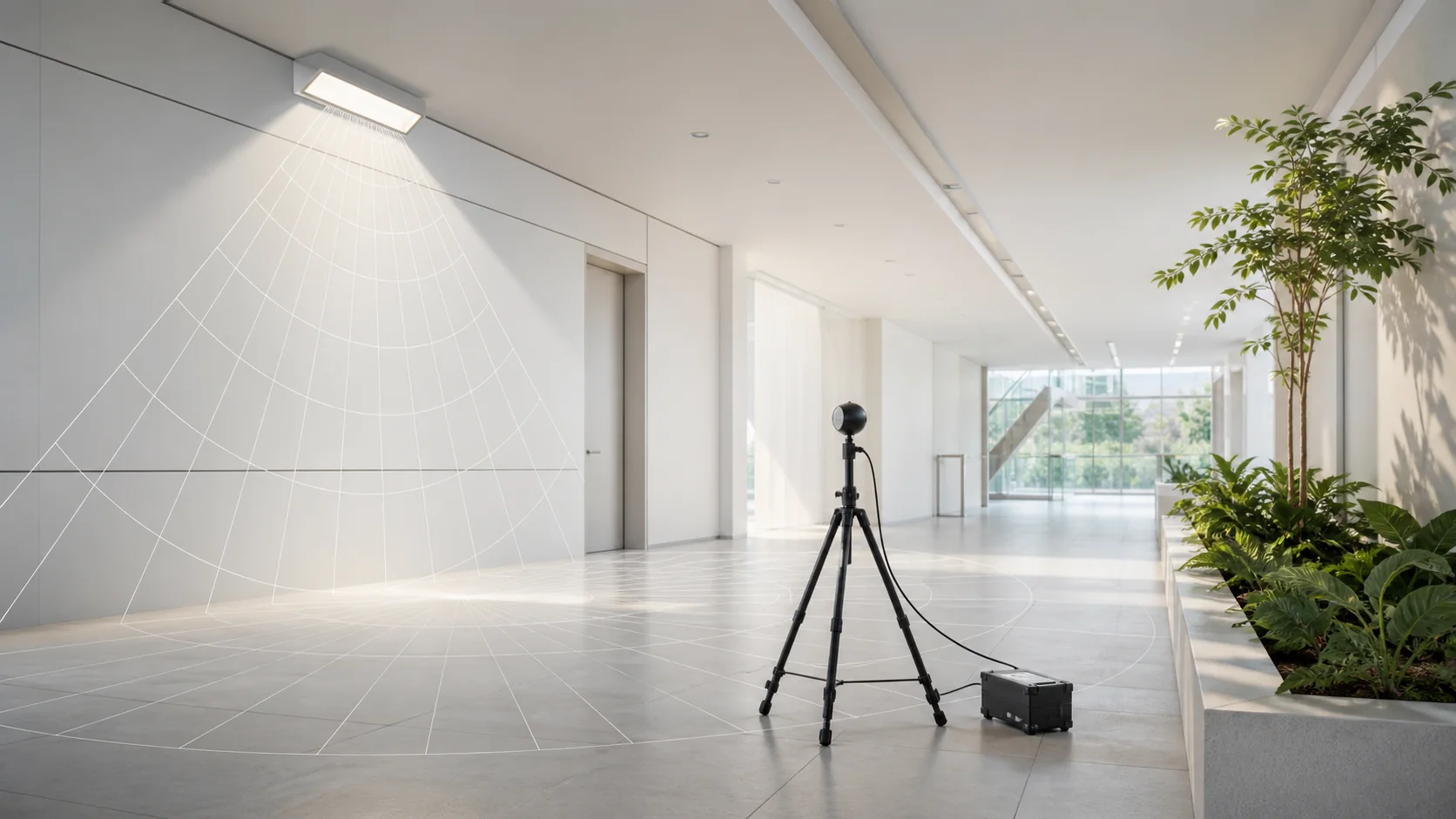
In brief: Specify emergency light lumen output for the exact model, emergency mode and rated duration, then request the photometric distribution needed to check the project illuminance target. Watts, LED count and normal-mode lumens do not prove emergency-mode performance.
The direct answer
An emergency-light RFQ should state the required emergency-mode luminous flux for the exact model and configuration, the rated duration at which that output must be available, and the photometric data needed to verify the project's illuminance target.
Do not use normal-mode watts, LED count or normal-mode lumens as substitutes. Lumens describe total luminous flux; lux describes illuminance reaching a surface; and the luminaire's intensity distribution helps determine where the light goes. Two luminaires with the same emergency lumens can produce different results on an escape route because their optics, mounting height, spacing and orientation differ.
The project designer sets the required lighting outcome under the rules adopted for the installation. The manufacturer supplies model-specific emergency output and photometric evidence. Procurement should keep those responsibilities connected but separate.
Watts, lumens, candela and lux are different RFQ fields
| Term | What it describes | What it can tell a buyer | What it cannot prove alone | |
|---|---|---|---|---|
| Watts (W) | Electrical power | Driver or LED power under a stated condition | Brightness, emergency duration or project illuminance | |
| Lumens (lm) | Luminous flux emitted by the luminaire | Total light output under the stated operating condition | Where the light reaches or whether a route meets its target | |
| Candela (cd) | Luminous intensity in a direction | Beam distribution and directional performance | The complete installed illuminance result | |
| Lux (lx) | Illuminance received on a surface | Light reaching the floor, task plane or sign surface | Which luminaire, spacing or configuration will deliver it |
NIST's SI guide defines the lumen as the SI unit of luminous flux and the lux as the SI unit of illuminance, equal to one lumen per square metre. That relationship does not mean a 100-lumen luminaire will create 100 lux across one square metre in a real installation. Light distribution, distance, aiming, room geometry and losses still affect the result.
ABB's current Emergi-Lite design guide makes the same practical distinction: emergency-lighting design needs photometric distribution, not a lumen number in isolation.
Why there is no universal emergency-lumen number
The question "How many lumens should an emergency light have?" has no single safe answer for building emergency lighting. The required result depends on the protected area, adopted rules, mounting layout, duration, optics and the exact emergency-lighting function.
An escape route, an open area, a high-risk task area and an internally illuminated exit sign do not have the same photometric job. Even within one category, a narrow corridor and a wide open floor can require different distributions. A higher lumen value can still leave dark areas if the beam is poorly matched to the layout, while a lower-output optic may place light more usefully on the required plane.
Government guidance in England describes the legal outcome as adequate illumination of escape routes when normal lighting fails. It also identifies doors, stairs, corridor intersections, changes in level, fire equipment and other points that may need coverage. It does not establish one global lumen rating for every luminaire.
Editorial recommendation: use lumens to compare product output only after the quotations use the same emergency condition. Use project photometric calculations or spacing data to decide whether that output is suitable for the installation.
Emergency lumens and normal lumens are not interchangeable
A maintained luminaire may operate at one output on normal mains power and a lower, battery-supported output during a supply failure. A product page that lists LED watts or normal lumens may therefore say little about its emergency performance.
For an emergency-output line to be usable, the supplier should identify:
- Exact luminaire model and revision
- Maintained, non-maintained or switchable operating mode
- Emergency luminous flux in lumens
- Rated emergency duration linked to that output
- Battery, emergency driver and LED configuration
- Measurement condition, initial or maintained value, and any stated correction factor
- Operating temperature relevant to the rating
The CIE report on photometry for emergency-lighting luminaires explains that absolute photometric values generally apply to LED emergency luminaires. The report also warns laboratories to check the current applicable procedure. Buyers should therefore ask which method and edition support the submitted data instead of accepting an unexplained percentage of normal output.
Duration and output must remain paired. Our emergency lighting battery duration guide explains why a runtime value without emergency output is not a complete performance claim.
What photometric evidence should a buyer request?
1. A model-specific data sheet
The data sheet should place emergency lumens, duration, battery, driver, operating mode and temperature on the same model record. If the product has selectable duration or output settings, request a separate value for each ordered setting.
2. Emergency-mode intensity data
Ask for an intensity distribution table, polar diagram, spacing table or a suitable electronic photometric file generated for the emergency condition. The file should identify the exact luminaire and test condition. A normal-mode photometric file should not be relabelled as emergency evidence.
BSI lists BS EN 13032-3:2021 as the current UK standard for presenting photometric data for emergency lighting of workplaces. The applicable format and edition still need to be confirmed for the destination project.
3. A project calculation
The lighting designer should use the luminaire data with mounting height, spacing, orientation, room geometry and the required calculation plane. Procurement should request the calculation assumptions and results, not only a supplier screenshot with no model or layout reference.
4. Evidence at the end of rated duration
Ask whether the submitted value is initial emergency output, output at a defined time or the value used to demonstrate performance through the rated duration. The acceptance method must match the project standard and approved specification. Do not invent an end-of-duration percentage when the project documents have not supplied one.
5. Traceability from sample to shipment
The approved sample record should connect the photometric data to the LED, lens, driver, battery and firmware or setting used in production. Pre-shipment checks can confirm configuration, switch-over, output and full-duration operation, but a handheld spot reading is not a substitute for a qualified project photometric assessment.
How to compare two emergency-light quotations
| Quotation field | Incomplete answer | Approval-ready direction | |
|---|---|---|---|
| Emergency output | "3 W LED" | Emergency luminous flux for the exact model and ordered setting | |
| Duration | "3 hours" | Rated duration paired with the stated emergency output | |
| Photometric evidence | Normal-mode brochure image | Emergency-mode intensity data or spacing information with model identity | |
| Project result | "High brightness" | Calculation or designer verification against the adopted illuminance criteria | |
| Test evidence | "Tested" | Named method, report scope, sample configuration and acceptance criterion | |
| Change control | "Equivalent parts may be used" | Controlled LED, optic, driver and battery combination with reapproval rules |
This comparison is intentionally evidence-led. A supplier can quote fewer lumens and still present the stronger technical offer if the optics, model traceability and project calculation are better documented.
Regional requirements must stay regional
For a UK project, BSI identifies BS EN 1838:2024 as the current standard for emergency-lighting luminous requirements and notes that it superseded the 2013 edition. BSI also describes a significant change: escape-route illumination now covers the total route width rather than only the centre line. The responsible designer should confirm the adopted edition and transition rules for the actual project.
For a US workplace, OSHA 29 CFR 1910.37 requires exit routes to be adequately lighted and separately gives an illumination requirement for exit signs. The exit-sign surface value should not be copied as a universal floor-lighting value or converted into a luminaire lumen specification.
IEC 60598-2-22:2021 covers particular safety requirements for emergency luminaires. A reference to the standard does not by itself supply the building layout, the regional illuminance target or proof that the ordered model has the quoted emergency output.
The procurement rule is simple: record the country, authority, standard and edition. Do not turn a UK, US or IEC reference into a global default.
An emergency-light lumen output RFQ block
Copy these fields into the quotation request and have the project designer complete the bracketed items:
- Destination country / jurisdiction: [location]
- Emergency-lighting function: [escape route / open area / high-risk task area / exit sign / local area]
- Applicable design standard and edition: [confirmed by project team]
- Product standard, certification and report scope required: [model-specific]
- Exact luminaire model and revision: [supplier entry]
- Operating mode: [maintained / non-maintained / switchable]
- Normal-mode output, if relevant: [lumens and watts]
- Required emergency luminous flux: [lumens under stated condition]
- Rated duration at the stated output: [minutes or hours]
- Emergency driver, LED, optic and battery configuration: [identifiers]
- Mounting height, orientation and spacing limits: [project values]
- Required illuminance criterion and calculation plane: [lux / uniformity / location]
- Photometric file or spacing table required: [format and emergency condition]
- Output test method and acceptance point: [initial / defined time / end of duration]
- Operating temperature for the rating: [range]
- Sample, inspection and change-control requirements: [method and quantity]
If the project team has supplied only a lux target, ask the manufacturer for photometric data and let the designer determine the model count and spacing. If the buyer has supplied only a lumen target, ask which surface, layout and standard that number is meant to satisfy.
If the operating mode is still undecided, use our maintained vs non-maintained emergency lighting guide before freezing the RFQ.
Zhuiming's confirmed product boundary
Hangzhou Dreamy Technology Co., Ltd. publishes model-level LED, battery and duration information for its emergency-lighting range. The current L114MN emergency downlight record includes a lumen figure, while the L107N-20W twin-head emergency light record includes LED power and a duration description.
Those catalog fields do not, by themselves, establish a uniform emergency-mode lumen rating or project spacing result. The quotation and approved sample must identify whether a value is normal or emergency output and connect it to the ordered driver, battery, optic and duration.
Zhuiming can evaluate LED power, lumen output, battery, duration and related electrical parameters through its OEM and ODM process. This is a company-confirmed customization scope, not a claim that every target is technically feasible or compliant in every market. Send the destination, layout, model, quantity, duration and photometric requirements for a configuration review.
Sources and scope
- NIST: SI units for luminous flux and illuminance
- CIE: Photometry of luminaires for emergency lighting
- IEC: IEC 60598-2-22:2021, emergency luminaires
- BSI: BS EN 1838:2024, emergency lighting for buildings
- BSI committee: BS EN 13032-3:2021, emergency-lighting photometric data
- US OSHA: 29 CFR 1910.37, exit-route lighting and marking
- UK Government: Fire-safety guide for offices and shops
- ABB Emergi-Lite: Emergency-lighting design guide
Sources reviewed 30 July 2026. This article provides procurement guidance. It does not replace a project-specific lighting design, adopted codes, photometric testing, certification review, a fire-risk assessment or approval by the responsible authority.
Frequently asked questions
How many lumens should an emergency light have?
There is no universal lumen number for every emergency light. The suitable output depends on the emergency-lighting function, optics, mounting layout, rated duration and the illuminance requirements adopted for the project.
What is the difference between emergency lumens and normal lumens?
Normal lumens describe output on the normal supply under stated conditions. Emergency lumens describe output from the emergency power configuration. A maintained luminaire can have different values in the two modes, so both must be identified separately.
Are watts enough to specify emergency light output?
No. Watts describe electrical power, not the light reaching an escape route. Request emergency luminous flux, rated duration and emergency-mode photometric distribution for the exact luminaire configuration.
Does a lumen value prove emergency-lighting compliance?
No. A lumen value does not prove the required lux, uniformity, coverage, duration or regional compliance. The project designer must use model-specific photometric data with the layout and adopted requirements.
What photometric data should an emergency-light buyer request?
Request emergency-mode luminous flux, intensity distribution or a suitable photometric file, spacing data, mounting assumptions, rated duration, test method and traceability to the ordered LED, optic, driver and battery configuration.