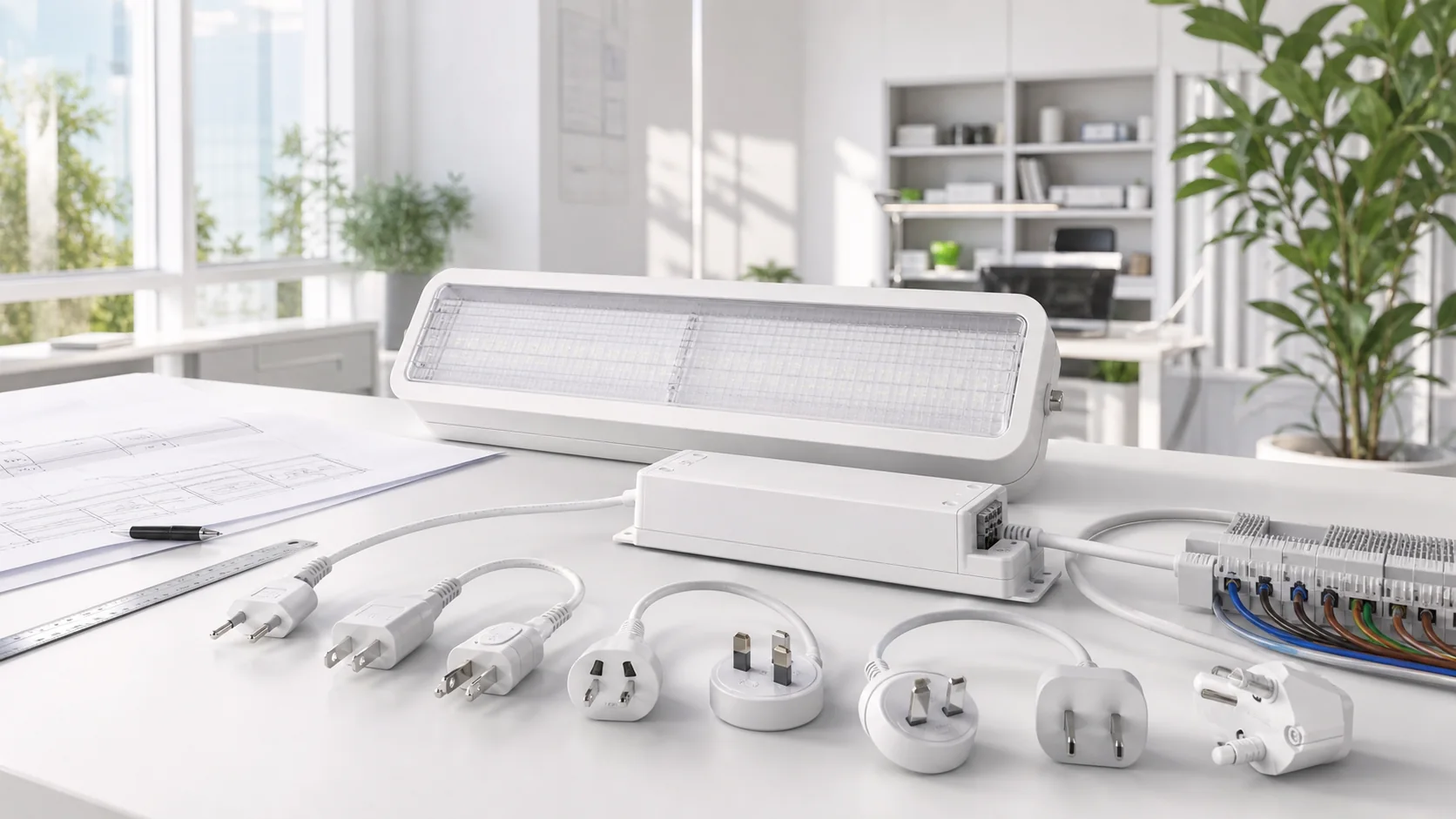
In brief: Specify emergency-lighting mains input as an exact voltage or range, frequency and wiring condition for the destination project. Then lock the driver, charger, label, instructions and approval evidence to that electrical configuration; battery voltage and plug shape are separate fields.
The direct answer
An international emergency-lighting RFQ should not say only "standard voltage" or name a destination country. State the building supply available at the luminaire, the acceptable input-voltage range, AC frequency, circuit and wiring arrangement, and the exact model configuration that must carry those ratings.
Then require the supplier's data sheet, rating label, wiring diagram and approved sample to agree. A label such as 100–240 V, 50/60 Hz can simplify sourcing when it is valid for the exact model, but it does not prove that the product has the correct termination, emergency function, certification or project approval for every country in that range.
Keep mains input separate from battery voltage. The building supply powers the luminaire and charges the emergency system; a 3.6 V, 7.4 V or 14.8 V battery value describes an internal DC subsystem, not the voltage to be connected by the installer.
Five electrical fields that buyers should not collapse into one
| RFQ field | What it describes | Approval question | |
|---|---|---|---|
| Mains input | AC supply presented to the luminaire | Does the complete ordered model accept the project's nominal voltage or stated range? | |
| Frequency | Supply cycles per second, usually stated in hertz | Is the driver and charging circuit rated for the project's 50 Hz, 60 Hz or both? | |
| Internal battery voltage | Nominal DC voltage of the battery pack | Is the pack approved with the ordered charger, protection circuit and emergency load? | |
| Emergency output circuit | DC or controlled output from the emergency driver to the light source | Is it compatible with the LED load, wiring and ordered emergency-output setting? | |
| Connection method | Terminal, cable entry, conductor arrangement, plug or connector | Does the physical and protective arrangement match the installation and local rules? |
These fields interact, but they are not interchangeable. An emergency conversion kit with a wide mains input can still be incompatible with the host LED driver. A luminaire with the correct battery voltage can still have the wrong charging input. A physically compatible plug does not change the voltage or frequency entering the product.
IEC 60038 treats standard supply voltages as reference values for supply systems and equipment design. Procurement still needs the actual project electrical schedule because the standard does not tell a buyer which circuit will be used in a particular building.
Why a country name is not a complete voltage specification
Country-level references are useful for early planning, but they do not replace project information.
The US Department of Energy describes 110–120 V at 60 Hz as the common US outlet context and notes that many other countries use 220–240 V at 50 Hz. That is a useful high-level distinction, not permission to assume that every North American commercial lighting circuit is 120 V or that every other market uses one identical supply.
The UK government identifies a 230 V domestic supply and 50 Hz power frequency. Japan shows why even a national voltage does not settle the frequency field: the Japan National Tourism Organization states that the country uses 100 V AC, with 50 Hz in eastern Japan and 60 Hz in western Japan.
International buyers should therefore request these project inputs before asking for a quotation:
- Country and installation address
- Nominal voltage at the intended lighting circuit
- Permitted operating range or supply tolerance, when the project documents define it
- 50 Hz, 60 Hz or another stated frequency
- Phase, line and neutral arrangement relevant to the product
- Protective-earth or equipment-class requirement
- Hardwired terminal, cable entry, cord set, plug or project connector
- Normal-supply monitoring and switching arrangement for the emergency function
Editorial recommendation: treat a country-voltage table as a lead, not an approval record. Have the project electrical designer or contractor confirm the circuit presented to the equipment.
Does 100–240 V, 50/60 Hz mean universal compatibility?
No. It means only that the named product input is declared for that range and those frequencies under the manufacturer's stated conditions.
For a wide-range claim to be useful, it should appear consistently on the exact model's data sheet, label artwork, quotation and approved sample. The associated driver or power supply and emergency charging circuit must be the components used in production. If the supplier changes a driver, charger, transformer, control board or battery-protection design, the approved electrical scope may change even when the housing looks identical.
"Universal voltage" also says nothing by itself about:
- Local emergency-lighting product standards
- Certification or registration for the destination market
- Building-level wiring and protection
- Plug, connector, cable entry or terminal arrangement
- Maintained, non-maintained or switchable behaviour
- Emergency lumen output and rated duration
- Electromagnetic compatibility or other market-access requirements
- Installation instructions and language
The safer buying phrase is "wide-range input for the stated model," followed by the exact voltage, frequency and evidence. Avoid treating "global voltage" as a synonym for global approval.
Mains input, battery voltage and LED voltage serve different jobs
A self-contained emergency luminaire normally has at least two electrical states. During normal supply, the input circuit powers or supervises the product and charges the battery. When the monitored normal supply fails, the emergency circuit uses stored energy to operate the light source under its approved emergency condition.
That architecture creates three separate specification questions:
1. Can the mains input and charging circuit accept the project supply? 2. Is the battery pack compatible with the charger, protection and operating temperature? 3. Can the emergency driver operate the specified LED load at the required emergency output for the rated duration?
The battery's amp-hour and voltage markings do not answer the first or third question. Our emergency lighting battery duration guide explains why the battery label alone cannot establish runtime. Our emergency light lumen output guide covers the separate evidence needed for emergency-mode light output.
For conversion kits, request the host-luminaire and driver information as well as the kit input. Compatibility is a system decision; a matching mains range does not prove that a kit can safely operate every LED lamp or electronic driver.
Frequency, driver and charger must be approved together
Frequency belongs beside voltage in the RFQ. A "230 V" answer without 50 Hz or 60 Hz leaves an electrical condition undefined.
Modern electronic supplies may support both frequencies, but buyers should not infer that from appearance or from the voltage range. The label and technical file should state 50/60 Hz when both are supported. For a single-frequency product, the quotation should identify the ordered frequency and the factory should prevent the wrong version from being labelled or packed.
An approval review should connect the stated input to:
- Normal-lighting driver, when the luminaire also operates in maintained mode
- Emergency driver or control board
- Battery charger and protection circuit
- Transfer or changeover behaviour after loss of the monitored supply
- Indicator, test switch and automatic-test functions, when present
- Component temperature ratings and the ordered housing
The maintained vs non-maintained emergency lighting guide explains the operating-mode decision. Voltage compatibility does not determine that mode, and a switchable label should not be assumed unless the model and wiring instructions support it.
Plugs and adapters are not an emergency-lighting approval strategy
Many building emergency luminaires are fixed equipment connected through project wiring. Where a product is cord-connected or uses a project connector, the plug or connector must be specified as its own field.
A travel adapter changes the physical interface; it does not convert voltage, change frequency, create protective earthing or establish suitability as fixed emergency equipment. Even when two countries use similar plug shapes, their supply and installation rules may differ.
For fixed luminaires, request the terminal identification, conductor requirements, protective-earth or equipment-class information, cable-entry details and wiring diagram. For plug-connected equipment, also specify the exact plug standard, cord construction and intended installation. The responsible electrical designer or contractor must confirm the final arrangement.
UL Solutions describes UL 924 as the North American standard for emergency lighting and power equipment. That regional certification route is not replaced by a travel adapter, an IEC reference or a wide-range driver.
Which documents should agree before sample approval?
1. Quotation and specification sheet
Record the exact model, input voltage or range, frequency, power and current data where applicable, operating mode, emergency output, duration, battery, installation and requested compliance scope.
2. Rating-label artwork
The label should identify the ordered electrical configuration and model. IEC 60598-1:2024 covers general safety, classification and marking requirements for luminaires and notes a clarification of marking for the nature of supply. The project team must still confirm which edition and national adoption apply.
3. Wiring diagram and instructions
The diagram should match the terminal arrangement and explain normal supply, switched or unswitched conductors where relevant, protective connections, indicators, test controls and any selectable settings. Do not approve generic instructions that show a different driver or terminal block.
4. Component and sample traceability
The approved sample should use the driver, charger, battery, control board and wiring that support the submitted rating. Record component identifiers or controlled equivalents so a later substitution triggers review instead of silently changing the electrical design.
5. Functional and market-specific evidence
The sample plan should check energization, charging indication, transfer to emergency mode, restoration behaviour and the ordered duration/output conditions under the agreed method. Certification reports, declarations or laboratory evidence must identify the model and scope required by the destination market.
IEC 60598-2-22:2021 gives particular requirements for emergency luminaires used on emergency power supplies not exceeding 1,000 V. A reference to this standard does not by itself prove the ordered model, voltage version or national market approval.
Regional rules must remain regional
The electrical compatibility decision has at least three layers:
1. Supply-system information for the project 2. Product safety and emergency-lighting requirements adopted in that market 3. Model-specific evidence for the exact ordered configuration
For the European Union, the Low Voltage Directive 2014/35/EU covers equipment within 50–1,000 V AC and 75–1,500 V DC. Its voltage scope is a regulatory boundary, not a statement that one product accepts every voltage inside it. Great Britain has its own Electrical Equipment (Safety) Regulations 2016 guidance, including manufacturer obligations for technical documentation and conformity assessment.
North American emergency-lighting equipment may follow UL 924 and related local code requirements. IEC 60598-2-22 is used in IEC-based markets, often through national or regional adoption. The responsible project team should name the required standard, national edition, certification and authority rather than asking a supplier for "international compliance."
An international emergency-lighting voltage RFQ block
Copy these fields into the quotation request:
- Destination country, city and project type: [buyer entry]
- Circuit nominal voltage at the luminaire: [V AC]
- Acceptable input range or tolerance: [project-confirmed]
- Supply frequency: [50 Hz / 60 Hz / stated alternative]
- Phase, line and neutral arrangement: [project-confirmed]
- Protective-earth or equipment class: [required arrangement]
- Connection: [hardwired terminal / cable entry / plug / connector]
- Exact emergency-light model and revision: [supplier entry]
- Operating mode: [maintained / non-maintained / switchable]
- Normal driver and control information: [if applicable]
- Emergency driver, charger and battery configuration: [identifiers]
- Emergency output and rated duration: [model-specific]
- Label language and electrical markings: [artwork approval]
- Wiring diagram and installation instructions: [document revision]
- Required product standard, national adoption and certification: [project entry]
- Sample test and report scope: [acceptance method]
- Component-change and reapproval rule: [buyer and supplier agreement]
If the project has not confirmed the circuit voltage and wiring arrangement, keep the quotation conditional. Do not freeze a production configuration from a country name alone.
How to compare voltage answers in quotations
| Supplier answer | Procurement risk | Approval-ready direction | |
|---|---|---|---|
| "Standard voltage" | The ordered supply is undefined | State exact nominal voltage or range and frequency | |
| "220 V" | No operating range, frequency or circuit context | Add tolerance/range, hertz and wiring arrangement | |
| "100–240 V universal" | May be mistaken for worldwide approval | Tie the range to the exact model, components, label and market evidence | |
| "Battery is 3.6 V" | Internal DC data is confused with mains input | List mains, battery and emergency-driver fields separately | |
| "Same product, different plug" | Electrical and installation differences are ignored | Approve supply rating, termination, protection and instructions together | |
| "IEC compliant" | No edition, national adoption, model or report scope | Name the requested standard, edition, certification and evidence |
Zhuiming's confirmed product boundary
Hangzhou Dreamy Technology Co., Ltd. publishes exact input data at model level. Most current catalog models state AC 220–240 V, 50/60 Hz. Selected models—including the L107N-20W twin-head emergency light and L217M-B emergency exit sign—state AC 110–240 V, 50/60 Hz.
Those catalog values apply only to the listed model record. They do not establish certification, wiring suitability or project acceptance in every market. The quotation and approved sample must confirm the ordered voltage version, components, label and documentation.
Zhuiming can evaluate voltage, battery, duration, LED output, housing, labels, instructions, packaging and wiring options through its OEM and ODM process. Customization is a review scope, not a promise that every requested range or certification is available for every model. Send the destination, circuit information, target standard, model and quantity for a configuration review.
Sources and scope
- IEC: IEC 60038:2009+AMD1:2021, standard voltages
- IEC: IEC 60598-1:2024, general luminaire safety, tests and marking
- IEC: IEC 60598-2-22:2021, particular requirements for emergency luminaires
- US Department of Energy: Electricity 101, voltage and frequency differences
- European Commission: Low Voltage Directive 2014/35/EU
- UK Government: Electrical Equipment (Safety) Regulations 2016 guidance
- UK Government: 230 V domestic supply and 50 Hz power frequency
- Japan National Tourism Organization: 100 V supply and regional 50/60 Hz frequencies
- UL Solutions: Emergency-lighting testing and certification
Sources reviewed 31 July 2026. This article provides procurement guidance. It does not replace the project's electrical design, adopted installation code, national product requirements, model-specific testing, certification review or approval by the responsible authority.
Frequently asked questions
What voltage should an emergency light use?
Use the voltage and frequency available at the project's intended lighting circuit and select an exact luminaire configuration rated for that supply. A country name or battery voltage is not enough to specify the mains input.
Can a 100–240 V, 50/60 Hz emergency light be used worldwide?
Not automatically. The range indicates declared electrical input compatibility for the exact model, but the connection method, emergency performance, certification, wiring rules and project approval remain market- and installation-specific.
Is emergency-light battery voltage the same as input voltage?
No. Input voltage is the building supply presented to the luminaire or kit. Battery voltage describes an internal DC energy-storage subsystem and must be matched to the approved charger, protection circuit and emergency driver.
Why must an emergency-light RFQ include frequency?
Voltage alone does not define an AC supply. The RFQ should state 50 Hz, 60 Hz or another project value so the driver, charger, control board, label and test scope can be approved for the actual supply.
Does changing the plug make an emergency light compatible with another country?
No. A plug or travel adapter changes only the physical connection. It does not convert voltage, change frequency, provide the required protective arrangement or establish emergency-lighting compliance.