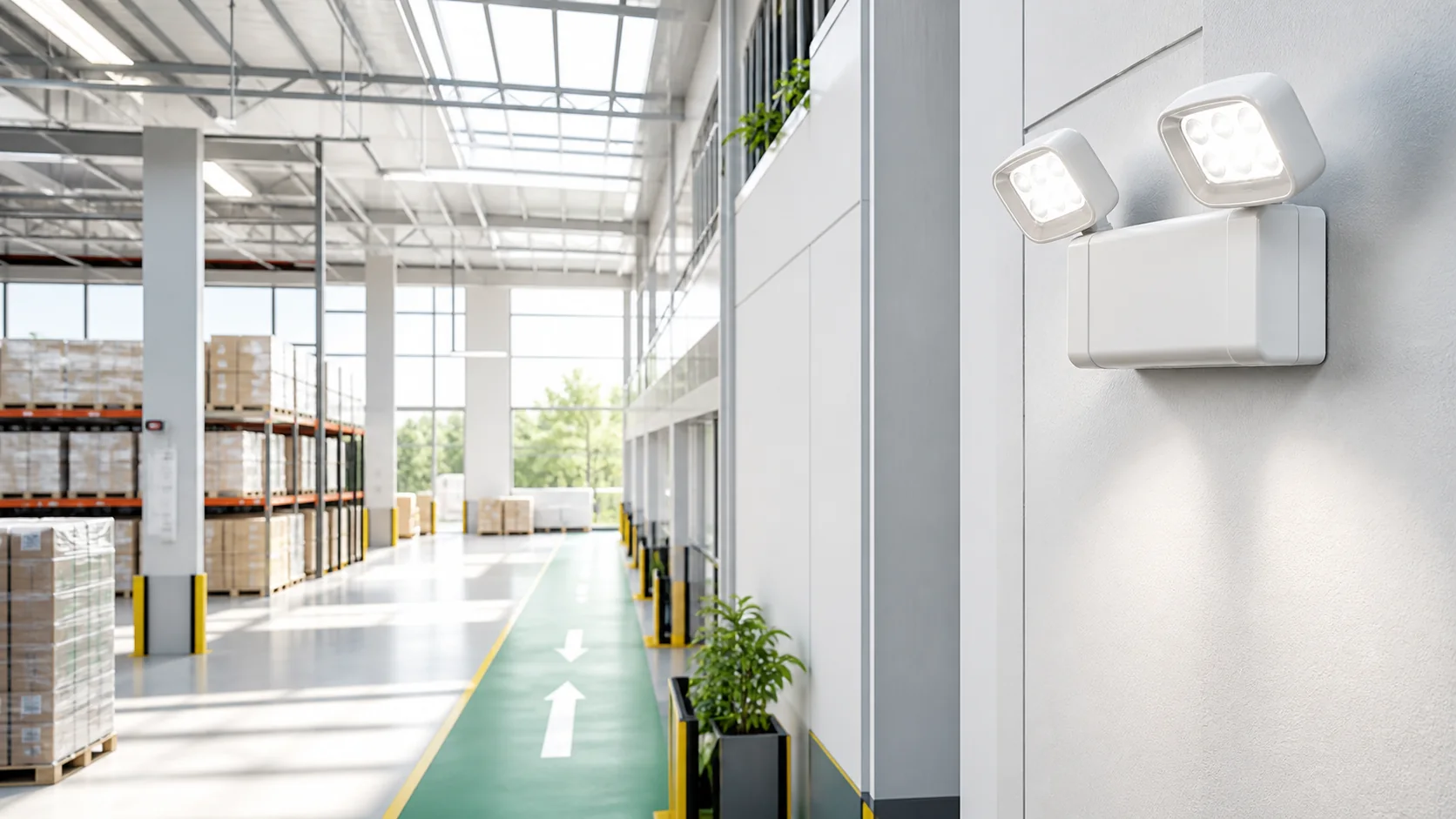
In brief: Choose a twin-head emergency light by defining the two lighting tasks, then approve the exact model, mounting position and recorded head directions with emergency-mode photometric evidence. Two adjustable heads, LED watts or battery amp-hours do not prove project coverage.
The direct answer
Choose a twin-head emergency light by assigning a clear lighting task to each head. Fix the intended mounting position and height, set the direction of both heads, and use emergency-mode photometric data for the exact model to check the project layout. Only then should the buyer lock the enclosure, input, operating mode, emergency output, rated duration, battery, test function, cable entry and service requirements.
Two heads are useful because they can direct light toward two different areas or combine their beams on one demanding area. They do not automatically double the usable coverage. Beam distribution, head angle, overlap, mounting height, obstructions, emergency output and the project criteria determine the result.
The safe procurement rule is to approve one complete configuration: exact luminaire, exact heads or optics, exact emergency setting, exact mounting position and recorded aiming directions. A generic request for a "twin-head emergency light" or "twin spot" leaves the most important coverage decisions unresolved.
What is a twin-head emergency light?
A twin-head emergency light is an emergency luminaire with two lamp heads attached to one body or power enclosure. Many products allow the heads to be adjusted independently, but the adjustment range, locking method, optic, mounting orientation and emergency output are model-specific.
"Twin-head emergency light," "dual-head emergency light" and "twin spot emergency light" are common search and purchasing terms. They do not define one universal beam, mounting height, duration, protection rating or approval route. The exact data sheet and installation instructions remain controlling for the ordered model.
IEC 60598-2-22:2021 specifies particular requirements for emergency luminaires on emergency power supplies not exceeding 1,000 V. That product-standard scope does not provide a project layout or prove that a particular pair of head directions will illuminate the required points.
Seven decisions that belong in the twin-head light approval
| Approval field | Why it changes the result | Evidence to request | |
|---|---|---|---|
| Lighting task for each head | Two heads can serve different points, overlap or leave a gap | Marked plan or elevation showing Head A and Head B targets | |
| Head adjustment and retention | A head is useful only if the required direction is permitted and remains set | Exact-model adjustment limits, installation instructions and sample check | |
| Emergency photometric coverage | Watts and total lumens do not show intensity at each point | Emergency-mode IES/LDT file, spacing table or project calculation | |
| Mounting position | Height, wall position and orientation change distance, angle and obstruction risk | Mounting drawing and the position used in the calculation | |
| Output, duration and battery system | These fields interact but are not interchangeable | Model-specific output, rated duration, battery, charger and test evidence | |
| Environment and enclosure | Dust, water, impact, temperature and outdoor exposure are separate conditions | IP/IK where required, material, temperature range and installation limits | |
| Installation and maintenance access | Cable entry, terminals, indicators, test controls and batteries must remain usable | Dimension drawing, wiring instructions and service clearances |
This article owns the dual-head aiming and combined-coverage decision. Use the emergency light lumen output RFQ guide for watts, lumens, candela, lux and photometric evidence; use the battery-duration guide for rated duration, recharge and re-entry requirements.
Start with two lighting tasks, not two lamp heads
Mark the points and route segments that need emergency illumination before choosing the product. Depending on the project, one head might serve a change of direction while the other serves a final exit, a stair flight, an alarm point, firefighting equipment or an open-area task. A different project may need both heads aimed into one larger area.
As a regional example, UK government fire-safety guidance for offices and shops identifies escape routes, exit doors, corridor intersections, final exits, stairs, level changes, alarm call points and firefighting equipment among the locations an emergency escape-lighting system should normally cover. The guidance also says this does not require a separate luminaire for every listed item. It applies to its stated UK context and is not a global layout rule.
In the United States, OSHA 29 CFR 1910.37 requires workplace exit routes to be adequately lighted so that an employee with normal vision can see along the route. OSHA's rule does not turn a product category or a head count into a spacing calculation.
The project designer should identify the governing jurisdiction, adopted code or standard, risk assessment and acceptance criteria. The supplier can then provide product data for the selected configuration.
How should the two emergency-light heads be aimed?
Aim each head at a named lighting task, not simply "left" and "right." The approval record should show what Head A protects, what Head B protects, the mounting position, the head directions and the evidence used to confirm the result.
A practical approval sequence is:
- Mark the protected points and route segments on the latest drawing.
- Fix the exact mounting surface, orientation and height used for the review.
- Assign Head A and Head B to distinct tasks, or state that the beams intentionally overlap.
- Obtain emergency-mode photometric data for the exact LED, optic and driver setting.
- Calculate the actual geometry with both head directions represented.
- Check whether racks, doors, ducts, signs, equipment or future fit-out can block either beam.
- Record the approved directions in a marked drawing, sample record or installation photograph.
- Require reapproval if the heads, optics, LED board, emergency setting or mounting position changes.
The record is important because "adjustable" is not a final setting. An installer who receives no aiming schedule must make a project decision on site without the evidence used during approval.
Why two heads do not prove twice the coverage
Two identical heads can produce very different results depending on how they are aimed. Widely separated beams may reach two locations but reduce overlap. Converging beams may increase light at one area while leaving another route segment under-served. A steep downward angle, shallow angle, high mounting point or nearby obstruction changes the usable distribution again.
Ask for evidence that answers the actual question:
| Evidence item | What it can establish | What it cannot establish alone | |
|---|---|---|---|
| Emergency lumens for the exact model | Total emergency-mode light output under stated conditions | Where the light reaches or whether both targets comply | |
| Emergency-mode IES or LDT file | Intensity distribution that can be used in a calculation | The final result without the project geometry and head directions | |
| Manufacturer spacing table | A stated arrangement under its listed conditions | A different height, optic, criterion, room or aiming arrangement | |
| Project photometric calculation | Predicted performance for the entered geometry and product data | Site conditions or product changes not represented in the model | |
| Commissioning measurement or acceptance record | Observed result for the installed system under the recorded method | Future performance without inspection, testing and maintenance |
Established manufacturers illustrate why the evidence must be model-specific. Thorn's Voyager Twinspot publishes adjustable-head and installation information for a named family. LEDVANCE's Emergency Twin Spot publishes model-level operating mode, battery duration, IP and test-function fields. These are examples of the evidence structure buyers should expect; they do not set requirements or performance claims for Zhuiming models.
There is no universal twin-head emergency-light spacing or aiming angle in this guide. Use the exact-model data and the adopted project criteria.
Battery size is not a coverage calculation
Battery voltage and amp-hours describe part of the internal energy system. They do not state emergency lumens, candela distribution, efficiency losses, regulated output, end-of-duration performance or project illuminance. A larger amp-hour number in one product is not proof that it provides more useful light than another product with a different voltage, driver, LED load or duration.
Approve emergency output and rated duration as separate fields. The Ni-Cd vs Li-ion emergency-light battery guide explains chemistry, compatibility, storage, transport and replacement boundaries. The maintained vs non-maintained guide explains when operating mode becomes a separate project decision.
IEC 60598-1:2024 covers general luminaire safety requirements and tests. UL Solutions identifies UL 924 as a North American standard for emergency lighting and power equipment and lists IEC 60598-2-22 among international emergency-lighting references. The destination market and exact model determine which evidence is relevant; neither reference establishes a global duration or battery-size rule.
Confirm mounting, environment and wiring before approving the sample
The mounting interface is part of the optical result and the product approval. The emergency wall light selection guide covers general housing orientation, cable entry and maintenance-access decisions without repeating the twin-head aiming task. Check the fixing pattern, structural surface, permitted orientation, cable entry, terminal space, equipment class, strain relief, head clearance and access for aiming. A door, pipe, cable tray or ceiling edge can limit head movement even when the product fits on the wall.
IEC 60529 classifies enclosure protection using the IP code. An IP rating does not by itself establish impact resistance, operating temperature, ultraviolet resistance, corrosion resistance, chemical exposure, drainage, condensation control or suitability for every outdoor location.
Write the environment before choosing the enclosure code: indoor dry corridor, dusty warehouse, covered loading bay, exposed exterior route, cold room or washdown area are different procurement conditions. Then let the responsible project team define the required protection and installation evidence.
Do not ask the factory to choose the building circuit. The electrical designer or qualified installer must confirm supply, isolation, protective arrangement and local wiring. Use the international emergency-lighting voltage guide to keep input voltage, frequency, driver, charger, terminal data, labels and instructions aligned.
Compare Zhuiming twin-head models by published catalog fields
Zhuiming's current catalog lists four products under Twin Head Emergency Lights. The table below repeats only published fields. It is not a photometric recommendation, certification claim or statement that a model is suitable for a particular project.
| Model | Published LED description | Published input | Published battery | Published IP | |
|---|---|---|---|---|---|
| L105N | 2 × 5 pcs 2835 SMD LED | AC 220–240 V, 50/60 Hz | Li-ion 3.7 V / 2.0 Ah | IP20 | |
| L106N | 2 × 30 pcs 3014 SMD LED | AC 220–240 V, 50/60 Hz | Ni-Cd 3.6 V / 3.0 Ah | IP20 | |
| L107N | 2 × 30 pcs 2835 SMD LED | AC 220–240 V, 50/60 Hz | Ni-Cd 6 V / 4.5 Ah | IP65 | |
| L107N-20W | 2 × 10 W COB LED | AC 110–240 V, 50/60 Hz | Li-ion 14.8 V / 4.4 Ah | IP65 |
Open the individual records for L105N, L106N, L107N and L107N-20W before creating a shortlist.
All four catalog records currently state non-maintained operation, wall surface mounting and more than three hours of duration. Those are company-published model fields, not universal twin-head requirements. The records do not publish an emergency-lumen figure, IES/LDT file, spacing table, head-angle range, IK code, operating-temperature range or certification scope. Request the missing evidence needed by the project rather than inferring it from LED count, watts, battery capacity or IP.
Twin-head emergency light sample-approval checklist
Use one controlled sample record for the complete configuration:
- Exact model, revision, LED board, optic or lens and both head assemblies
- Permitted mounting surface, orientation and height used in the layout
- Adjustment range and retention of each head after positioning
- Marked Head A and Head B aiming directions
- Emergency-mode output and the condition or time point at which it is stated
- Emergency photometric file, spacing table or calculation revision
- Rated duration, battery, charger and emergency driver configuration
- Input voltage, frequency, operating mode and wiring diagram
- Indicator, manual-test, remote-test or automatic-test function as ordered
- IP, IK, temperature, material and environmental evidence required by the project
- Cable entry, terminals, fixing pattern, head clearance and service access
- Labels, instructions, reports, packaging and component-change controls
If any optical, electrical, battery, enclosure or mounting field changes after sample approval, identify the change and repeat the affected review. Do not allow a cosmetic approval photograph to stand in for photometric or technical approval.
A twin-head emergency light RFQ block
Copy these fields into the request for quotation:
- Destination country, project type and adopted standard or code: [buyer entry]
- Drawing reference and emergency-lighting criteria: [buyer entry]
- Lighting task for Head A: [protected point or area]
- Lighting task for Head B: [protected point or area]
- Mounting surface, orientation and height: [project value]
- Required head adjustment and locking or retention: [project requirement]
- Emergency-mode photometric evidence: [IES/LDT, spacing table or calculation]
- Emergency output and rated duration: [project requirement]
- Operating mode: [maintained / non-maintained / other]
- Input voltage, frequency and wiring arrangement: [project-confirmed]
- Battery chemistry, voltage, capacity and replacement requirement: [approved configuration]
- Environment and required IP, IK, temperature or material evidence: [project-confirmed]
- Test function and indicator: [manual / remote / automatic / other]
- Fixing, cable entry, terminals and service clearances: [required details]
- Certification, reports, labels, instructions and sample tests: [approval package]
- Component-change and reapproval rule: [buyer and supplier agreement]
If the buyer has not supplied a layout, lighting criteria or head targets, keep any coverage statement conditional. A manufacturer can provide product data and a technical proposal; it cannot safely approve an unknown building layout from a room name or floor area alone.
How Zhuiming supports a twin-head shortlist
Hangzhou Dreamy Technology Co., Ltd. publishes model records for its twin-head emergency-light range and can review voltage, battery, duration, LED output, housing, colour, labels, instructions and packaging through its OEM and ODM process.
That is a customization scope, not confirmation that every optic, head angle, enclosure code, test function, certification or environmental condition is available for every model. Final suitability depends on the exact configuration, destination requirements, project layout, technical evidence and approved sample.
Send the drawing, two head targets, mounting position, environment, voltage, duration, quantity and approval evidence required for a technical and commercial review.
Sources and scope
- IEC: IEC 60598-1:2024, general luminaire safety requirements and tests
- IEC: IEC 60598-2-22:2021, particular requirements for emergency luminaires
- IEC: IEC 60529 consolidated edition, enclosure protection and IP code
- UK Government: Fire safety risk assessment for offices and shops
- US OSHA: 29 CFR 1910.37, workplace exit-route lighting and marking
- UL Solutions: Emergency-lighting testing and certification, including UL 924 and IEC context
- Thorn Lighting: Voyager Twinspot model-level aiming and installation information
- LEDVANCE: Emergency Twin Spot model-level operating, battery, IP and test data
Sources reviewed 2 August 2026. This article provides procurement guidance. It does not replace a project emergency-lighting design, fire-risk assessment, photometric calculation, electrical design, installation instructions, adopted national requirements, commissioning test or approval by the responsible authority.
Frequently asked questions
How do I choose a twin-head emergency light?
Assign a lighting task to each head, then approve the exact model, mounting position and recorded head directions with emergency-mode photometric evidence. After coverage is checked, lock the enclosure, input, mode, output, duration, battery, test and installation fields.
Do two emergency-light heads provide twice the coverage?
Not automatically. Usable coverage depends on each beam distribution, head angle, overlap, mounting height, obstructions, emergency output and the project criteria. Both heads must be represented in the exact-model layout or spacing evidence.
What is the correct aiming angle for a twin-head emergency light?
There is no universal aiming angle. Aim each head at a named project task and verify the directions with emergency-mode photometric data for the exact model, mounting position and height.
Does a larger battery make a twin-head emergency light brighter?
Battery voltage and amp-hours do not prove emergency brightness or coverage. Compare the exact model's emergency output, photometric distribution, regulated driver behavior and rated duration as separate approval fields.
Is an IP65 twin-head emergency light suitable for outdoors?
IP65 alone does not prove complete outdoor suitability. The project may also need evidence for temperature, ultraviolet exposure, corrosion, impact, cable entry, sealing, drainage, installation and local requirements.