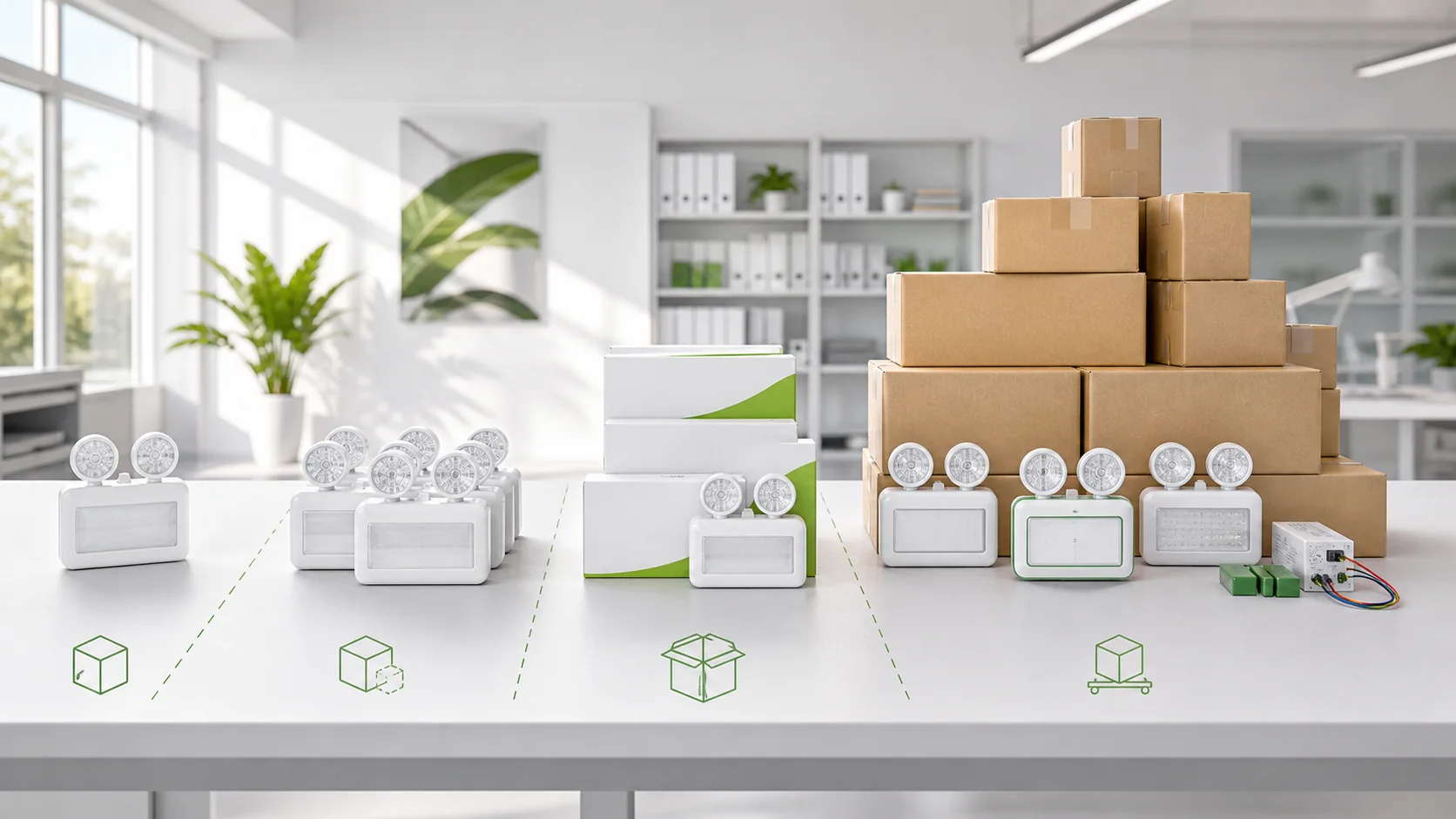
In brief: Emergency light MOQ usually changes when a request creates model-specific setup, materials, testing, documentation or inventory that cannot be shared with standard production. Compare MOQ by sellable configuration, not only by the total pieces on the purchase order.
The direct answer
Emergency light MOQ is not one factory-wide number. It is the smallest commercially and technically workable quantity for a defined model, electrical configuration, brand and packaging version under a particular quotation. A standard product can use existing materials and instructions, while a private-label or electrical variant may require separate artwork, purchased components, production setup, approval work and inventory.
That is why two requests for the same housing can receive different minimum order quantities. A neutral-carton order, a printed-logo order, a multilingual retail-pack order and a battery or driver change are four different production commitments. Buyers should ask what creates each threshold, which costs are one-time, whether variants may be combined, and what remains model-specific.
This guide explains the commercial logic and a buyer's comparison method. It does not establish a universal emergency lighting MOQ or replace a current quotation. Final quantity, feasibility, pricing, certification work and delivery depend on the exact model, destination, configuration and approved files.
MOQ should be quoted per sellable configuration
A useful starting unit is the **sellable configuration**: one model and revision with one electrical build, one brand identity and one packaging/document set. If any of those fields changes in a way that requires separate materials, setup, identification or approval, the supplier may need to treat it as another MOQ line.
For example, 1,000 total luminaires are not automatically one 1,000-piece run when the order contains two housings, two input voltages, three carton languages and four brand labels. The quotation should show whether the threshold applies per model, per electrical variant, per artwork, per packaging language, per color or to the combined order.
The GS1 GTIN Management Standard is not an MOQ rule, but it demonstrates why product identity and packaging hierarchy cannot always be collapsed into one line. Changes to primary brand, declared functionality, dimensions or pack quantity can require distinct trade-item identification under its stated conditions. Local law and the buyer's distribution system may impose additional requirements.
What usually changes the emergency light MOQ
| Order scope | Typical production difference | Question that explains the MOQ | |
|---|---|---|---|
| Standard catalog configuration | Existing bill of materials, labels and standard packing can be shared with normal production | Is the quantity per model, and is any finished or component stock available? | |
| Neutral packaging or added sticker | Standard carton remains, with a controlled label or insert added | Is there a label-print minimum, application setup or separate inspection step? | |
| Custom logo or model label | New artwork, print method, positioning master and label approval | Does the threshold apply per logo, color, model and print location? | |
| Custom printed packaging or manual | Separate artwork, plate or digital setup, material conversion and language revision | Is MOQ set by the finished-product run, the packaging supplier or both? | |
| Electrical or battery change | Variant-specific components, assembly instructions, test criteria and evidence review | Which driver, charger, battery, LED, wiring and documents become unique? | |
| Housing, optic, PCB or tooling change | Engineering, prototypes, tooling, validation and dedicated materials | Is the offer a pilot build, a tooling project or a repeatable mass-production program? |
These are common manufacturing questions, not claims that every supplier uses the same processes. Digital printing may avoid a plate; shared components may reduce a material threshold; an uncommon component may raise it. Ask the supplier to name the controlling constraint instead of accepting "factory policy" as the complete explanation.
Six drivers behind a customization MOQ
1. Production setup and changeover
Changing a model can require line clearance, tooling or fixture setup, work-instruction release, printing adjustment, first-off inspection and traceability separation. The U.S. National Institute of Standards and Technology describes quick changeover as reducing the time between the last good piece of one run and the first good piece of the next. The practical implication is bounded: changeover is real production work, but its cost and duration are factory- and process-specific.
2. Custom-material purchasing
Labels, cartons, manuals, batteries, drivers, cables, housings and molded parts may come from different suppliers with their own pack sizes, conversion quantities or production schedules. The finished-light MOQ may therefore be governed by a component or packaging commitment rather than final assembly capacity. Request the supplier's quantity basis, usable yield, expected surplus and ownership of leftover custom material.
3. Non-recurring work
Artwork checks, engineering review, programming, samples, fixtures, print setup, tooling and certification-body work can occur before repeatable units are produced. The U.S. Small Business Administration's break-even guidance separates fixed and variable costs; that accounting principle helps explain why one-time work is more expensive per unit in a short run. It does not calculate an emergency-light MOQ for a factory.
Ask whether a lower quantity is possible if a disclosed setup, tooling or development charge is paid separately. A transparent charge can be easier to compare than hiding every one-time cost inside a unit price.
4. Approval and evidence scope
Electrical, material or structural changes can require new internal verification, laboratory work, certification review, photometric evidence, battery documentation or revised declarations. IEC 60598-1:2024 covers general luminaire safety requirements and tests; IEC 60598-2-22:2021 covers particular requirements for emergency luminaires. Neither standard supplies a commercial MOQ, but their scopes show why a changed electrical configuration cannot be priced as artwork alone.
Private labeling can also change the approval route. The European Commission's 2022 Blue Guide says that, for Union harmonisation legislation, a person placing a product on the market under its own name or trademark is considered the manufacturer under the stated conditions. UL Solutions' Multiple Listing Service addresses identical UL Certified products offered under different brand names. These are regional and program-specific examples, not worldwide rules.
5. Variant fragmentation
Every extra model, voltage, battery, color, legend, language or brand can divide a seemingly large order into smaller controlled runs. Fragmentation adds file versions, material segregation, line changes, first-off approvals and inspection records. It also creates a greater chance that one low-volume variant leaves unused custom stock.
6. Inventory and repeat-order risk
A supplier may be more flexible when a standard component is shared across established products or when a repeat program has a credible release schedule. Flexibility should still be written into the quotation or supply agreement. A forecast is not a purchase order, and a promised future quantity should not silently transfer obsolete custom-material risk to either party.
Zhuiming's published starting MOQ references
Hangzhou Dreamy Technology's OEM and ODM page currently publishes the following starting references:
| Published scope | Starting reference | |
|---|---|---|
| Standard products | 300 pcs | |
| Custom logo | 500 pcs | |
| Custom packaging | 500 pcs | |
| Battery or parameter customization | 1,000 pcs |
These figures are company-confirmed website references reviewed on 11 August 2026. They are not universal industry minimums, a promise for every model or a substitute for a quotation. The final MOQ can change with model mix, logo method, packaging structure, language, color, electrical configuration, component availability, required evidence, inspection scope and delivery schedule.
Zhuiming's public inquiry page also states that estimated quantity, destination market and customization details help prepare a more relevant response. The buyer should provide those fields before treating any starting reference as applicable.
Can different emergency light models share one MOQ?
Sometimes, but only when the quotation says which constraint can be shared. Two models may use the same logo artwork yet require different labels, cartons, drivers, batteries or assembly runs. Conversely, several variants may share a master carton material or standard component while retaining separate finished-product thresholds.
Ask for a matrix instead of a yes-or-no answer:
- total order quantity;
- quantity per model and electrical configuration;
- quantity per logo, label, packaging artwork and language;
- shared and model-specific materials;
- setup or tooling charges;
- allowed mixed-model rule;
- surplus custom-material treatment;
- repeat-order validity period.
Do not combine variants on paper merely to reach a number. The final order, labels, inspection records and shipment quantities must still identify the actual configurations.
How to request a lower MOQ without weakening control
A lower first order is most realistic when the request removes a genuine constraint or pays for it clearly. Buyers can discuss these options:
1. Keep the standard electrical configuration and change only a controlled brand label. 2. Use the standard neutral carton with an approved label or insert instead of a fully printed retail box. 3. Reduce the number of models, colors, voltages, languages or packaging versions in the first release. 4. Pay a disclosed setup, sample, engineering or tooling charge separately where the supplier offers that route. 5. Approve a pilot quantity with explicit limits, then define the mass-production MOQ separately. 6. Use a framework or repeat-order schedule only when both parties agree on releases, prices, material ownership and expiry. 7. Accept documented leftover custom materials for a later order only after agreeing storage, shelf life, revision control and disposal responsibility.
Do not lower MOQ by deleting necessary testing, using unapproved components, copying certification marks, mixing electrical variants under one label or skipping sample approval. The safer objective is a smaller controlled order, not a cheaper undocumented product.
Separate sample quantity, pilot quantity and mass-production MOQ
A sample order proves defined attributes; it does not prove that the factory can purchase and control every custom material at the same unit economics as mass production. A pilot run may test tooling, work instructions, packaging and inspection on a limited lot. Mass-production MOQ addresses repeatable supply under the final commercial and technical configuration.
Record the purpose and acceptance gate for each stage. Use the emergency lighting sample approval checklist before authorizing production and the factory testing before shipment checklist for the released lot. The OEM emergency lighting customization guide explains how to classify the requested changes before MOQ is quoted.
Compare supplier quotes on the same quantity basis
| RFQ field | What the buyer should state | What the supplier should return | |
|---|---|---|---|
| Base configuration | Model, revision, destination and reference specification | Exact offered model and excluded options | |
| Variant matrix | Quantity by model, voltage, battery, mode, color and language | MOQ for each sellable configuration and any permitted combination | |
| Branding | Logo file, label locations, model naming and print method | Artwork setup, approval method and per-brand threshold | |
| Packaging | Unit pack, master carton, insert, manual, barcode and language | Packaging-material minimum, surplus policy and per-artwork threshold | |
| Electrical change | Input, driver, charger, battery, duration, output, wiring and test feature | Component minimum, engineering review and evidence impact | |
| One-time charges | Sample, setup, fixture, tooling, testing and certification scope | Separate charges, refund or amortization terms and ownership | |
| Repeat program | Forecast, release sizes and expected dates | Price and MOQ validity, material reservation and expiry terms | |
| Change control | Approved sample, files, bill of materials and inspection plan | Revision control, substitution rules and reapproval trigger |
Compare unit price only after these fields align. A 300-piece neutral-carton quote and a 300-piece custom-electrical retail-pack quote are not equivalent offers even when both show the same headline quantity.
Build the MOQ request from a controlled base model
Use the emergency light specification sheet guide to define the model and the international voltage guide, battery-duration guide and emergency lumen-output RFQ guide for electrical fields. Representative catalog starting points include the L103N emergency bulkhead, L107N-20W twin-head emergency light, L124N-R emergency downlight, L217M-B emergency exit sign and F355MN emergency conversion kit.
Product pages show reference configurations, not guaranteed customization or approval scope. Send Zhuiming the model, destination, quantity by variant, logo and packaging files, electrical changes, required evidence, sample plan and repeat-order expectation for a project-specific quotation. The responsible buyer, importer, designer, certification body and local authority retain their respective decisions.
Sources and scope
- NIST Manufacturing Extension Partnership: Lean and Process Improvement, including quick changeover/setup reduction
- U.S. Small Business Administration: break-even point and fixed-versus-variable cost framework
- GS1: GTIN Management Standard
- IEC: IEC 60598-1:2024, general requirements and tests for luminaires
- IEC: IEC 60598-2-22:2021, particular requirements for emergency luminaires
- European Commission: Blue Guide on EU product rules, 2022 edition
- UL Solutions: Multiple Listing Service for differently branded certified products
- Zhuiming: OEM and ODM customization scope and starting MOQ references
Sources reviewed 11 August 2026. Verified facts and regional or program-specific examples are identified with their sources. Zhuiming's starting references are company-published commercial information. The MOQ driver model, quote matrix and negotiation options are editorial procurement guidance, not accounting, legal, certification or engineering rules. Final commercial and technical terms belong in the current quotation and approved order documents.
Frequently asked questions
What is the MOQ for emergency lights?
There is no universal emergency light MOQ. The applicable minimum depends on the exact model, electrical configuration, branding, packaging, materials, approval work and order schedule. Zhuiming currently publishes a 300-piece starting reference for standard products, subject to project quotation.
Does adding a custom logo increase emergency light MOQ?
It can. A custom logo may require separate artwork, label or printing setup, first-off approval and variant control. Zhuiming currently publishes a 500-piece starting reference for custom-logo orders, but the final threshold depends on model, logo method, color and location.
Why can custom packaging have a separate MOQ?
Custom packaging can be governed by carton, insert, manual or label production quantities as well as the finished-light run. Ask whether the threshold applies per artwork, language, model and pack size, and who owns any surplus custom material.
Can different emergency light models be combined to meet MOQ?
Only when the quotation explicitly permits it. Models may share logo artwork or standard components but still require separate electrical builds, labels, cartons, setup and inspection. Request the MOQ by sellable configuration and the exact mixed-model rule.
How can a buyer negotiate a lower emergency light MOQ?
Reduce real constraints: keep the standard electrical build, use neutral packaging with an approved label, limit first-order variants, or pay disclosed setup and tooling charges separately where offered. Do not reduce required testing, evidence, labeling control or sample approval.