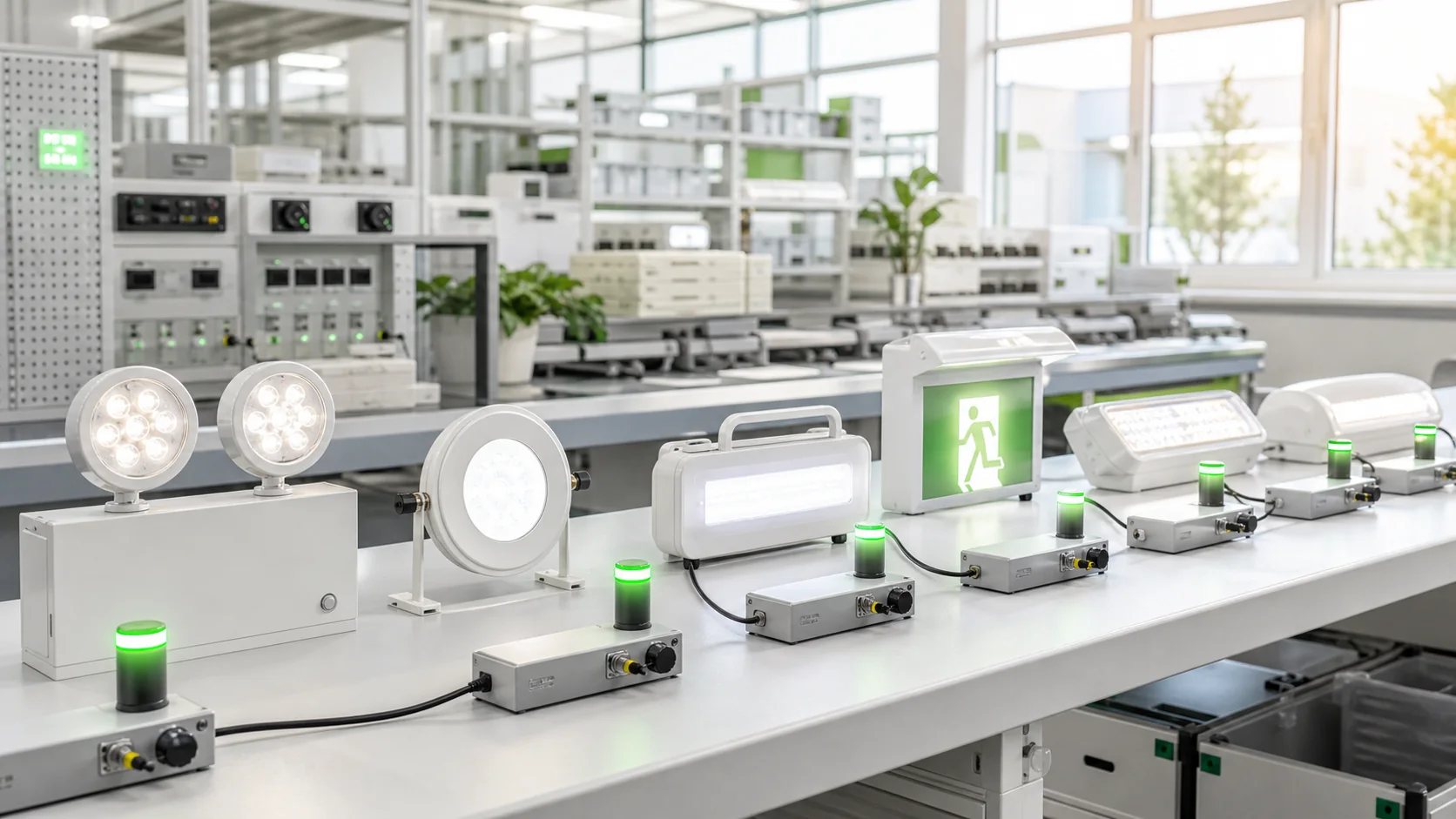
In brief: Emergency light testing before shipment should follow a written control plan that links the approved product configuration to incoming checks, in-process controls, finished-unit functions, battery and photometric evidence, labels, packaging, nonconformity closure and a signed release record.
The direct answer
Emergency light testing before shipment should not begin with a generic final-inspection form. It should begin with the approved order specification and convert each critical requirement into a factory control: what is checked, at which production stage, on how many units, by which method, against which acceptance criterion, and in which record.
A practical plan covers incoming component identity, first-off or pilot-unit approval, in-process assembly controls, finished-unit electrical and emergency functions, battery and duration evidence, photometric identity, labels, accessories, packaging, nonconformity closure and final release. The depth and frequency of each check must match the exact model, product class, destination requirements, certification file, buyer specification and production risk.
No single observation proves shipment conformity. A lamp switching to battery power does not prove rated duration. A duration result does not prove emergency light output. A carton count does not prove the electrical configuration inside the housing. A certificate name on a document does not prove that the shipped model and revision are within its scope.
Factory testing, certification and shipment inspection answer different questions
Factory quality control asks whether production continues to reproduce the approved configuration and whether defined process and product checks pass before release. Type testing or certification evaluates a product against a stated standard and certification path. A buyer's pre-shipment inspection samples or examines the completed lot against an agreed inspection plan. Installed-system testing checks the emergency-lighting system after installation and during service.
These activities can share evidence, but they are not substitutes for one another. Use the emergency lighting sample approval checklist to freeze the pre-production baseline. This article owns the factory control sequence. A later shipment-inspection plan should define lot formation, random selection, defect classes, sample sizes and acceptance rules without turning those choices into universal defaults.
IEC 60598-1:2024 gives general safety requirements and tests for luminaires, while IEC 60598-2-22:2021 gives particular requirements for emergency luminaires. IEC 61347-2-7 covers battery-supplied electronic controlgear for self-contained emergency lighting, and IEC 62034 covers automatic test systems. Those scopes help identify controlled characteristics; they do not publish one universal factory checklist for every model, market and order.
An eight-stage emergency light factory testing plan
| Production stage | Main control job | Release evidence | |
|---|---|---|---|
| Incoming materials | Confirm the identity and approved status of safety-critical, performance-critical and artwork-controlled components | Receiving record, supplier or batch traceability, component label or data check, deviation status | |
| First-off or pilot unit | Prove that the line setup, controlled bill of materials, wiring, dimensions and workmanship match the approved configuration | Signed first-off record, photographs, measurements and configuration references | |
| In-process assembly | Prevent reversed polarity, incorrect wiring, loose connections, missing insulation, wrong fasteners and unapproved substitutions from moving downstream | Station checklist, torque or process records where specified, operator and inspector traceability | |
| Approved routine safety checks | Apply the routine production tests required by the applicable product design, standard or certification file | Test result, equipment ID, method or program revision and pass/fail record | |
| Finished-unit function | Verify normal operation as applicable, loss-of-supply changeover, emergency operation, restoration, charging indication, test control and self-test or communications features | Functional-test record tied to model, batch and test program | |
| Battery, duration and output evidence | Confirm battery identity and connection, then obtain the agreed charge/discharge, rated-duration and emergency-output evidence on the defined basis | Conditions, sample identity, elapsed time, output method, result and disposition | |
| Final identity and packing | Match labels, instructions, accessories, legends, barcodes, quantities, protection and carton marks to approved revisions | Final inspection and packaging record with artwork and packing-list revisions | |
| Nonconformity closure and release | Contain failures, correct causes, define retest scope and authorize only a controlled lot for shipment | Nonconformity report, corrective action, retest evidence and signed release |
This table is a framework, not a claim that every check must be performed on every unit. The control plan should state whether a characteristic is checked 100 percent, by a defined sample, periodically, at setup, after a change or by external laboratory evidence. Safety-critical routine tests and ordinary visual checks should not be assigned the same frequency merely for administrative simplicity.
Write the control plan before mass production
At minimum, give each test line these fields:
| Control-plan field | Question it must answer | |
|---|---|---|
| Characteristic | What exact configuration, dimension, function or document is controlled? | |
| Stage and responsibility | Where is the check performed, and who can accept or stop production? | |
| Basis | Which approved drawing, specification, instruction, standard, certification file or buyer criterion applies? | |
| Method and equipment | How is the check made, and which equipment or test program is used? | |
| Frequency | Is it first-off, 100 percent, sampled, periodic, change-triggered or lot-specific? | |
| Acceptance criterion | What unambiguous result is pass, fail or conditional? | |
| Record and traceability | How is the result tied to model, revision, batch, date, operator and equipment? | |
| Reaction plan | What is contained, corrected, retested and escalated after a failure? |
Do not use "check normally" or "test OK" as criteria. If a buyer needs a voltage range, operating mode, duration, emergency output, IP rating, legend, battery pack or label revision, identify the exact approved value and evidence source. The international voltage guide, maintained versus non-maintained guide, battery-duration guide and Ni-Cd versus Li-ion guide keep those configuration decisions separate.
Incoming checks should protect the approved configuration
Incoming inspection is not limited to visible damage. Decide which received items can change electrical safety, emergency performance, thermal conditions, installation or destination documents. Depending on the product, the controlled list can include the housing and diffuser, LED module, optic, normal and emergency driver, charger, battery pack, connectors, wire, terminals, strain relief, insulation, fasteners, test switch, indicator, printed label, legend panel, instructions and packaging.
For each controlled item, compare the supplier or internal part number, revision and critical attributes with the approved bill of materials. Record batch or date-code traceability when the purchase specification requires it. A component that looks similar is not an approved equivalent. If a battery, driver, LED, optic, wire route or enclosure part changes, reopen the technical and approval consequences before releasing it to the line.
Incoming inspection does not prove finished-luminaire performance. It prevents an unverified input from becoming hidden inside completed production.
First-off and in-process controls catch errors before final test
The first assembled unit after line setup, a model change or a controlled process change should be compared with the approved drawing, bill of materials, wiring diagram and sample record. Verify product identity, dimensions, mounting features, cable entries, terminals, earthing provision where applicable, component position, battery retention, connector polarity, wire routing, insulation, fasteners, diffuser or legend fit, indicator and test-control location.
In-process controls should focus on defects that are difficult to detect after closing the housing. Examples include trapped wires, reversed battery connectors, incomplete terminal insertion, loose mechanical retention, missing insulation barriers, damaged seals, wrong LED or optic, incorrect legend orientation and unrecorded component substitution.
The reaction plan matters as much as the check. When a station finds a failure, identify the affected production window, contain the units, correct the cause, define the retest scope and record disposition. Repairing the one observed unit without investigating the surrounding lot is not a complete control response.
Finished-unit functional testing needs a defined sequence
For the exact ordered configuration, the functional sequence can include:
1. Confirm product identity, wiring configuration and required initial charge or conditioning state. 2. Apply the specified normal supply and verify normal-mode behavior where the product has a maintained or combined function. 3. Simulate loss of the normal supply using the approved safe method and verify changeover to emergency operation. 4. Check the intended emergency light source, heads, legend or connected load, not merely an indicator. 5. Operate the test button, remote input, self-test or monitoring interface when those features are part of the ordered model. 6. Restore the normal supply and verify the specified restoration behavior and charge indication. 7. Record faults, unusual flicker, noise, intermittent connections or inconsistent indications and apply the reaction plan.
An indicator LED is useful evidence only when its meaning is defined by the exact product instructions. Eaton explains that a simple green indicator on some self-contained products may show that voltage is applied through the battery charge circuit; it does not by itself prove battery capacity or full emergency performance. Tridonic's SELFTEST documentation shows that function tests, duration tests and fault indications are distinct within its product family. Those details illustrate what instructions should define, not fault codes that can be transferred to another device.
For conversion products, control the host luminaire, normal driver, LED load, emergency kit, battery, wiring and thermal integration as one finished configuration. The emergency conversion kit buyer guide explains why a broad input or lamp-wattage label is not sufficient compatibility evidence.
Electrical safety routine tests must follow the approved product basis
Routine production safety checks can include protective-earth continuity for Class I construction, insulation or electric-strength checks, polarity or wiring checks and other tests defined by the applicable product standard, certification file or approved factory procedure. The exact test, connection points, limits, duration and equipment belong in that controlled basis.
Do not copy a voltage, current, resistance or test time from a different product family into a generic checklist. Product class, construction, destination standard and certification conditions can change the method. Testing should be performed by trained personnel using suitable, identified equipment with calibration or verification status controlled by the quality system.
A buyer does not need confidential engineering files to request credible release evidence. The record can identify the program or instruction revision, equipment, date, batch, number tested, failures, retest and release status without disclosing proprietary circuit details.
Battery, duration and photometric checks are related but not interchangeable
Start with battery identity: chemistry, pack model, nominal rating, connector, polarity, retention, production code and approved charger relationship. Battery amp-hours alone do not prove emergency duration, and a short function test does not prove usable capacity.
When the order requires a rated-duration test before shipment, define the charging or conditioning procedure, ambient condition, sample basis, emergency-mode configuration, output observation or measurement, start and end criteria, elapsed time, failure rule and recovery or recharge check. Record the exact tested unit or sample. Do not reduce the result to "still on" if the specification requires a stated emergency output during the period.
Photometric evidence should remain tied to the exact LED, optic, diffuser or legend, emergency driver setting, battery condition and duration point. The emergency light lumen-output RFQ guide explains the difference between watts, lumens, candela, lux and distribution data. A factory may use controlled parameter checks to monitor production, while an accredited laboratory or defined photometric method may be needed for formal performance evidence. Intertek's lighting services illustrate that electrical and photometric performance are separate test areas; the buyer should name the required report and model scope rather than request "a light test."
Do not turn type or validation tests into unsupported routine claims
Ingress protection, impact protection, thermal testing, EMC, abnormal-operation tests, long-duration aging, transport simulation and full photometric characterization can be important. They are not automatically appropriate as routine tests on every shipment or every unit.
Decide whether each item is established by type-test or certification evidence, periodic verification, change validation, a sampled order-specific test, external laboratory work or another controlled method. Reopen the evidence when a relevant component, material, enclosure, seal, optic, driver, battery, wiring or manufacturing process changes.
This distinction prevents two common errors: promising that every production unit receives a destructive or laboratory-scale test, and omitting change-triggered verification because an older report exists.
Final identity, documents and packaging are part of release
Before closing cartons, match the finished product and pack to controlled order revisions. Check the model and electrical rating label, emergency markings, battery information, legend and arrow where applicable, input and operating mode, installation instructions, destination languages, warning labels, accessories, mounting hardware, barcode, inner protection, quantity, carton mark and shipping mark.
Form-factor checks remain model-specific. A wall or bulkhead emergency light needs its permitted orientation, enclosure and cable-entry configuration controlled. A twin-head light needs head movement and retention. A recessed or surface emergency downlight needs the correct ceiling interface. An exit sign needs the approved legend, arrow, face count, viewing direction and mounting hardware.
Never treat a packaging correction as permission to open and modify a certified or sealed product without an approved process. Record rework, affected quantities and reinspection.
What should be in the shipment release file?
A useful release file is proportionate to the order and can include:
- Purchase order, approved specification, model and revision
- Approved sample, drawing, bill of materials and artwork references
- Control plan and current test or work-instruction revisions
- Incoming, first-off and in-process records for critical characteristics
- Routine safety and finished-functional test summary
- Battery, duration and emergency-output evidence required by the order
- Equipment identification and calibration or verification status where relevant
- Nonconformities, corrective actions, concessions and retest results
- Label, instruction, accessory and packaging revision checks
- Quantity and lot traceability
- Inspector, reviewer and release authorization with dates
- External laboratory, certification or third-party inspection records when contractually required
The buyer should agree which records are supplied, retained at the factory or available during an audit. A polished test report created after a dispute is less useful than contemporaneous records tied to the released lot.
Copyable pre-shipment factory checklist
- [ ] Order, model, revision and destination are identified
- [ ] Approved specification, drawing, bill of materials and sample are current
- [ ] Critical incoming components match approved identities
- [ ] First-off unit matches wiring, construction, dimensions and workmanship requirements
- [ ] In-process checks cover hidden and safety-critical assembly points
- [ ] Routine safety test method and criteria match the approved product basis
- [ ] Normal and emergency operating modes are checked as applicable
- [ ] Loss-of-supply changeover and restoration behavior pass
- [ ] Test button, indicator, self-test or communications features pass as ordered
- [ ] Battery pack identity, connection, polarity and retention pass
- [ ] Duration and emergency-output evidence uses defined conditions and sample basis
- [ ] Photometric identity matches the approved LED, optic, diffuser or legend
- [ ] Labels, warnings, instructions and destination languages match approved revisions
- [ ] Accessories, mounting parts, barcodes and quantities are correct
- [ ] Inner protection, carton and shipping marks match the packing specification
- [ ] Failures are contained, corrected and retested with traceable disposition
- [ ] Changes and concessions have buyer or responsible-party approval where required
- [ ] Release records identify lot, date, inspector, reviewer and authorization
How Zhuiming supports a controlled release
Hangzhou Dreamy Technology Co., Ltd. publicly describes incoming material inspection, in-process sampling, finished-product functional testing, battery charge and discharge testing, photometric parameter testing, pre-shipment sampling, packaging inspection and customer or third-party inspection support on its Factory & Quality page. The same page states that test scope is matched to the product and project and that aging tests can be arranged rather than represented as standard for every order.
The company's OEM and ODM process moves from requirement review and sample confirmation to production and inspection. Representative catalog records include the L103N emergency bulkhead, L107N-20W twin-head emergency light, L124N-R emergency downlight, L217M-B emergency exit sign and F355MN emergency conversion kit.
These are company-confirmed process and catalog statements, not a claim that every listed test, frequency, certificate or acceptance criterion applies to every model. Send the target market, model, quantity, approved specification, required standards, test plan, evidence list and inspection arrangement for order-specific technical and commercial review.
Sources and scope
- IEC: IEC 60598-1:2024, general requirements and tests for luminaires
- IEC: IEC 60598-2-22:2021, particular requirements for emergency luminaires
- IEC: IEC 61347-2-7:2011+AMD1:2017+AMD2:2021, battery-supplied emergency controlgear
- IEC: IEC 62034:2012, automatic test systems for battery-powered emergency escape lighting
- UL Solutions: emergency lighting testing and certification, including regional UL 924 context
- Signify: emergency-lighting application checklist with function and indication fields
- Tridonic: SELFTEST emergency-device functional description
- Eaton: emergency-lighting testing and battery options
- Intertek: lighting testing and certification capabilities
Sources reviewed 9 August 2026. This article separates verified standard scopes, regional certification context, manufacturer-specific examples, Zhuiming's published process capabilities and editorial procurement recommendations. It is not a certificate, laboratory report, universal test procedure, AQL sampling plan, installed-system maintenance schedule or statement of worldwide compliance.
Frequently asked questions
What should emergency light testing before shipment include?
It should include a controlled order and model identity, incoming critical-component checks, first-off and in-process controls, approved routine safety checks, finished-unit emergency functions, battery and duration evidence, photometric identity, labels, documents, packaging, nonconformity closure and signed lot release.
Should every emergency light receive the same factory tests?
No. The control plan should define which characteristics are tested on every unit, by sample, periodically, at setup, after a change or through external evidence. The basis depends on the product, risk, destination requirements, certification file and buyer specification.
Does a short emergency function test prove battery duration?
No. A short test can confirm changeover and basic emergency operation, but rated duration needs defined charging, conditioning, ambient, output, elapsed-time and acceptance conditions on the agreed sample basis.
Is factory testing the same as a pre-shipment inspection?
No. Factory testing controls production stages and release evidence. A buyer or third-party pre-shipment inspection evaluates the completed lot under a separately agreed sampling and acceptance plan. Neither replaces required type testing or certification.
What records should a buyer request before emergency lights ship?
Request the approved specification and revision, control-plan references, test summaries required by the order, battery and emergency-output evidence, nonconformity and retest status, label and packaging checks, lot traceability and signed release authorization.