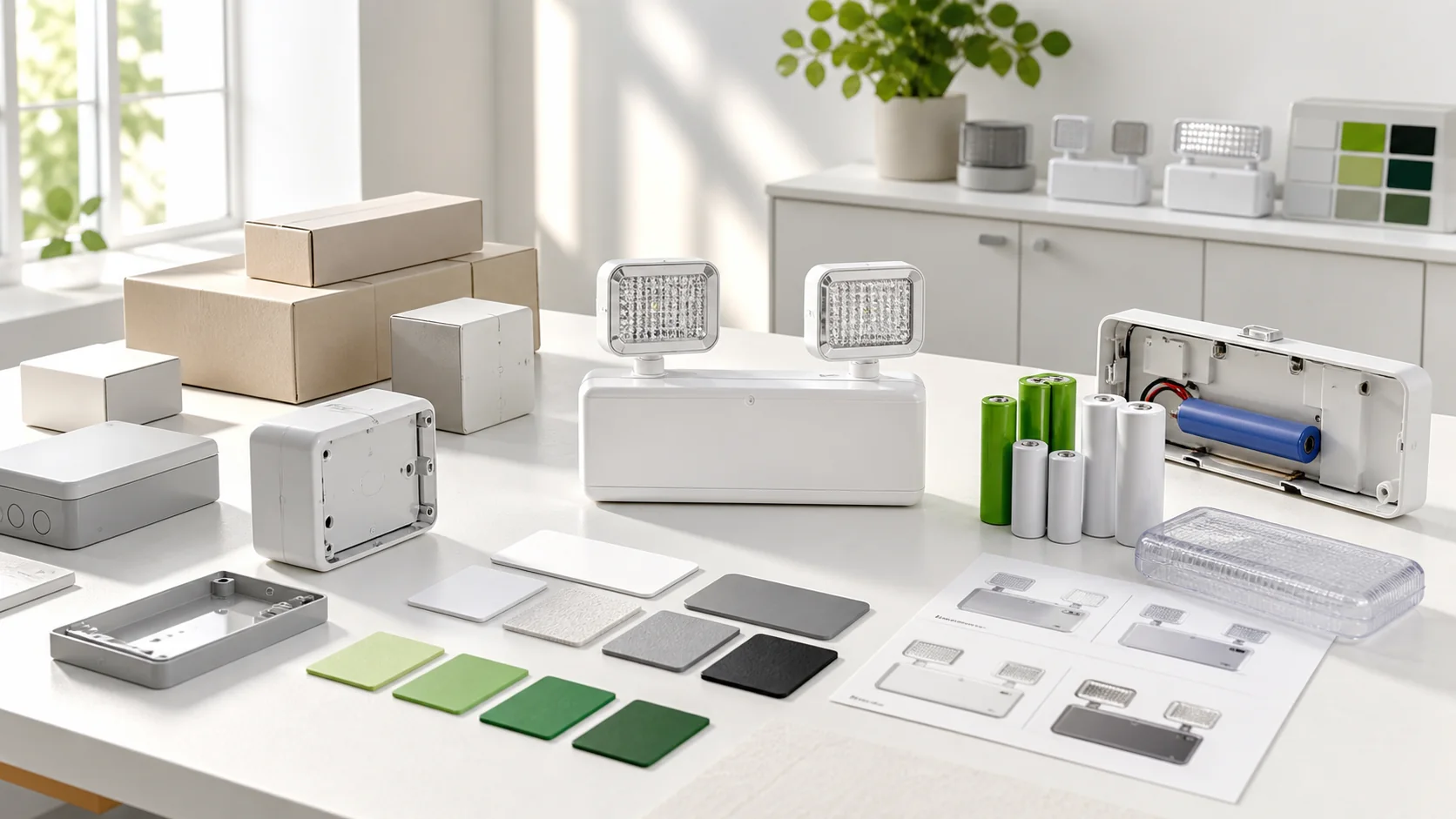
In brief: Plan an OEM emergency lighting project by separating brand artwork, packaging, electrical configuration and product-development changes, then approve each layer against the exact model, destination requirements, evidence and sample.
The direct answer
OEM emergency lighting customization should be approved in layers. Start with the exact base model and destination market, then separate brand artwork, packaging and documents, electrical configuration, mechanical changes and new product development. For every requested change, record what changes, what stays fixed, which drawing or document controls it, whether existing test or certification evidence still applies, and what the approved sample must prove before mass production.
A logo change is not automatically a harmless commercial edit. Packaging can carry model identity, warnings, traceability and legally required economic-operator information. A different battery, driver, LED, optic, voltage, wiring method, enclosure or mounting part can change safety, emergency output, duration, thermal behavior, installation and approval scope. The safest buying question is therefore not “Do you offer OEM?” but “Which parts of this exact configuration may change, and what re-evaluation does each change require?”
OEM, private label and ODM are not fixed technical categories
Suppliers use OEM, private label, white label and ODM in different ways. In this guide:
- **Private label** means an existing product is supplied under the buyer's brand, normally with controlled changes to the product label, packaging and documents.
- **OEM customization** means a manufacturer produces an agreed configuration for the buyer, often starting from an existing platform and adding brand, packaging, parameter or component options.
- **ODM development** means the supplier contributes design or engineering work for a more substantial product, structural or functional change.
These are practical sourcing definitions, not universal legal classifications. Responsibility follows the target market's law, the economic operators involved, whose name or trademark appears on the product, and who controls the design and conformity process. The European Commission's 2022 Blue Guide, for example, says a person that has a product manufactured and places it on the Union market under its own name or trademark is considered the manufacturer. Current UK guidance similarly states that an importer or distributor placing a product on the Great Britain market under its own name or trademark assumes manufacturer responsibilities. These are regional examples, not worldwide rules.
Classify the customization before asking for price
| Customization layer | Typical request | Main approval question | |
|---|---|---|---|
| Brand identity | Logo, brand name, model name, housing print or label artwork | Does the marked identity match the responsible parties, order code and evidence path for the destination? | |
| Packaging and documents | Color box, neutral carton, barcode, manual language, carton mark or insert | Are artwork, warnings, traceability, accessories and model references complete and revision-controlled? | |
| Appearance and interface | Housing color, finish, legend, plug, cable entry, terminal arrangement or mounting kit | Does the change affect material, fit, ingress protection, installation, visibility or approval scope? | |
| Electrical configuration | Input voltage, frequency, driver, battery, duration, operating mode, LED output or test feature | Has the complete electrical, thermal, battery, emergency-performance and evidence relationship been reviewed? | |
| Structural or ODM development | New housing, dimensions, optic, PCB, mold, mounting method or system interface | What design ownership, validation plan, tooling approval, certification path and change control are required? |
The table is a risk map, not a universal hierarchy. A small artwork change can be consequential when it alters a rating label or certification mark. A larger cosmetic change may remain low risk only if materials, construction, interfaces and evidence are demonstrably unaffected.
Start from one controlled base model
Choose the product family first, then identify the full order code, revision, construction and existing evidence. Do not begin with an unqualified request such as “three-hour emergency light with our logo.” That phrase does not define operating mode, emergency output, battery, input, mounting, enclosure, test function, legend, destination standard or certification route.
Use the emergency light specification sheet guide to normalize the base model. Carry the same model identity into the quotation, customization matrix, drawings, artwork, sample record, bill of materials and purchase order. If the supplier proposes several electrical or enclosure variants under one family name, mark the selected combination rather than treating every option as included.
A practical OEM brief should state:
- destination country or region and the responsible importer, distributor or brand owner;
- intended application and product form;
- base model, drawings or reference sample;
- quantity and expected repeat-order pattern;
- mains input, frequency, operating mode, emergency output and rated duration;
- battery, test or monitoring option, enclosure, mounting and environmental conditions;
- logo, label, packaging, barcode, manual and language requirements;
- required standards, certification or declaration route and exact evidence requested;
- sample, inspection, delivery and change-control expectations.
Logo and private-label approval needs more than a print file
For a private-label emergency light, freeze the legal brand name, product model, logo file, print method, color reference, size, position and orientation. Then create a label schedule showing every identity and rating location: product label, battery label where applicable, carton, manual, barcode, warranty or service insert and certification marking controlled by an approved program.
Do not copy a certification mark onto new artwork because it appears on the supplier's standard label. UL Solutions describes its Multiple Listing Service as a route for identical UL Certified products to be offered under different brand names, with the new brand included in UL Product iQ. Intertek's ETL Multiple Listee guidance likewise distinguishes a brand belonging to the original applicant from a third party's brand. The correct path depends on the certification program and exact product; the existence of a supplier certificate does not authorize an unrelated private-label mark or model name.
Brand approval should also define who owns the artwork, who supplies trademark authorization when needed, who checks spelling and translations, and who can release a revision. A signed PDF alone is weak control if the production file, label material, print location and purchase order use different revisions.
Treat packaging as a controlled product interface
Packaging customization can include a neutral carton, printed color box, inner protection, molded insert, accessory bag, barcode, shipping mark, pallet label and destination-language documents. Approve the packaging as a system around the exact model, not as a detached graphic design.
Check at least four jobs:
1. **Identity:** model, variant, quantity, color, voltage and barcode match the unit inside. 2. **Protection:** the product, battery, legend, heads, diffuser, mounting parts and accessories are restrained for the agreed handling and transport path. 3. **Information:** warnings, instructions, economic-operator details and regulated marks follow the destination review. 4. **Execution:** dimensions, materials, print process, colors, sealing method, packing sequence and carton marks are reproducible and inspectable.
Transport testing, environmental claims and battery-shipping documents depend on the product and route. Do not claim that a generic carton design is export-compliant everywhere. The planned label-and-manual guide will address artwork content in more detail; this article owns the customization scope and approval handoffs.
Electrical customization changes a configuration, not one number
An electrical request must be evaluated as a connected product system. Changing the battery can affect the charger, emergency driver, duration, output, temperature, protection and transport documentation. Changing emergency output can affect battery sizing, thermal conditions, optic or photometric evidence and rated duration. Changing mains input can affect the driver, charger, terminals, wiring diagram, label and instructions.
Review these fields together:
| Requested field | Connected fields that must be reopened | |
|---|---|---|
| Input voltage or frequency | Driver and charger version, terminals, wiring, label, instructions and destination evidence | |
| Maintained or non-maintained mode | Circuit architecture, normal-light function, wiring, switch or control interface and instructions | |
| Battery chemistry or capacity | Charger, connector, protection, retention, duration, emergency output, temperature, transport and replacement basis | |
| Emergency duration | Battery, emergency load, output profile, charging conditions, test method and sample evidence | |
| LED power or emergency lumens | LED and driver, optic, thermal conditions, battery, duration and photometric file | |
| Self-test or monitoring | Emergency controlgear, indicators, test schedule, communications, commissioning and system compatibility |
IEC 60598-1:2024 provides general safety requirements and tests for luminaires, while IEC 60598-2-22:2021 gives particular requirements for emergency luminaires. Their scopes help explain why construction, marking, batteries and emergency functions must be reviewed as a complete product. They do not prescribe one universal OEM process or prove that a requested configuration complies in a destination market.
For detailed decisions, use the international voltage guide, maintained versus non-maintained guide, battery-duration guide, Ni-Cd versus Li-ion guide and emergency lumen-output RFQ guide. An emergency conversion kit also requires approval of the host luminaire, normal driver, LED load, emergency kit, battery, wiring and thermal integration.
Decide whether existing evidence still applies
Create a change-impact register before sampling. For each requested change, identify the affected drawing, bill of materials, label, instruction, test report, certificate, declaration, photometric file and factory control. Record one disposition: no technical impact with documented basis; document update only; internal verification; laboratory or certification-body review; new test or listing; or rejected pending redesign.
Certification scope must be confirmed with the responsible body or program when required. UL Solutions' Follow-Up Services guidance says certified production is checked against the construction evaluated in the original certification and directs necessary construction changes through a revision process. That principle is a useful warning beyond UL projects: do not assume that an electrical, material or structural change inherits evidence created for another configuration.
For each claimed approval, ask:
- Which company and brand appear in the certificate, listing or declaration?
- Which model numbers, suffixes, factory and construction are covered?
- Does the private-label model require a multiple-listing or equivalent process?
- Has the certification body reviewed the requested component or construction change?
- Do the sample label, datasheet, report, quotation and order identify the same configuration?
Do not describe an IEC standard as a product certificate, a laboratory report as a universal approval, or a supplier's declaration as authorization for every private-label variant.
Use a gated OEM emergency lighting approval flow
| Gate | Required output before moving forward | |
|---|---|---|
| Requirement review | Destination, base model, quantity, customization matrix, compliance path and open questions | |
| Feasibility and change impact | Technical proposal, affected documents and tests, exclusions, tooling need and evidence plan | |
| Commercial confirmation | Quotation with configuration, setup or tooling charges, quantity basis, sample scope and indicative schedule | |
| Artwork and engineering release | Approved drawings, label schedule, packaging artwork, wiring, bill of materials and revision list | |
| Customized sample approval | Signed sample record covering identity, function, emergency performance, construction, artwork, documents and packing | |
| Production preparation | Controlled files, first-off criteria, inspection plan, approved suppliers or components and change restrictions | |
| Shipment release | Production and inspection records, required test evidence, packaging check, nonconformity closure and lot authorization |
The emergency lighting sample approval checklist supplies the buyer sign-off structure. The factory testing before shipment checklist turns the frozen configuration into production controls. MOQ and lead time should be quoted after this scope is known; the next planned guides will explain why brand, packaging, electrical and tooling changes create different commercial thresholds and schedules.
Freeze change control before mass production
The approved sample is a reference, not permission for silent substitution. State which attributes may not change without written review: battery, driver, LED, optic, wire, connector, protection device, housing resin, seal, dimensions, mounting parts, label, manual, packaging material and production location where relevant.
Every approved change should carry a request number, reason, affected models and lots, technical assessment, evidence decision, updated documents, sample or validation result, buyer approval when required and effective date. If a change affects a certified construction, involve the responsible certification path before production. If it affects only artwork, still update all controlled copies and inspection masters.
How Zhuiming supports OEM and ODM projects
Hangzhou Dreamy Technology Co., Ltd. publishes an OEM and ODM customization scope covering logo and brand identity, neutral or custom packaging, housing color, dimensions and structural design, labels, manuals, wiring, LED output, battery, emergency duration, input voltage, operating mode, installation and mold development. The company's process moves from requirement review through proposal, sampling, customer approval, production, inspection and delivery.
These are company-confirmed evaluation capabilities, not a promise that every requested configuration, material, certification or schedule is available for every model. The public OEM page currently gives starting quantity references by customization type; final MOQ, sample timing, production timing, tooling, pricing and evidence scope belong in the current quotation for the exact project.
Representative starting platforms include the L103N emergency bulkhead, L107N-20W twin-head emergency light, L124N-R emergency downlight, L217M-B emergency exit sign and F355MN emergency conversion kit. Product pages are reference configurations, not evidence that all listed customization options or approvals apply automatically.
Send the destination, buyer or brand role, base model, quantity, electrical requirements, logo files, label and packaging brief, required evidence, sample plan and delivery target. Zhuiming can evaluate the manufacturing proposal; the responsible buyer, importer, project designer, certification body and local authority retain their respective approval duties.
Sources and scope
- IEC: IEC 60598-1:2024, general requirements and tests for luminaires
- IEC: IEC 60598-2-22:2021, particular requirements for emergency luminaires
- European Commission: Blue Guide on EU product rules, 2022 edition
- UK Government: placing UKCA- or CE-marked products on the Great Britain market
- UL Solutions: Multiple Listing Service for differently branded certified products
- UL Solutions: Follow-Up Services and certified-construction changes
- Intertek: ETL Multiple Listee program FAQ
Sources reviewed 10 August 2026. This article separates verified standards scopes, EU and Great Britain regional responsibility examples, certification-program examples, Zhuiming's published capabilities and editorial procurement recommendations. It is not legal advice, a certificate, a test report, a conformity declaration, a universal private-label procedure or confirmation that a specific OEM model complies in any market.
Frequently asked questions
What can be customized on an OEM emergency light?
Depending on the model and project, customization can cover logo and labels, packaging and manuals, housing color, mounting parts, input voltage, operating mode, battery, duration, emergency output, wiring, test features and structural development. Each requested change needs a model-specific feasibility and evidence review.
Is private labeling an emergency light only a logo change?
No. A private-label project can affect product identity, economic-operator information, rating labels, packaging, documents and certification listings. The buyer should confirm the destination responsibilities and approval path before artwork is released.
Can an existing emergency-light certificate be used for a private-label brand?
Not automatically. Confirm the certification program, certificate or listing owner, covered models and construction, permitted brand and model names, manufacturing location and whether a multiple-listing or equivalent process is required.
Which electrical customization requests need re-evaluation?
Changes to input voltage, driver, charger, battery, emergency output, duration, operating mode, wiring, LED, optic, self-test or monitoring can affect connected safety, thermal, photometric, battery and approval evidence. Review the complete configuration rather than one field.
What should a buyer approve before OEM emergency lights enter production?
Approve the exact model and bill of materials, drawings, wiring, label schedule, packaging and manual revisions, compliance-evidence plan, customized sample, inspection criteria, change restrictions and signed production release.