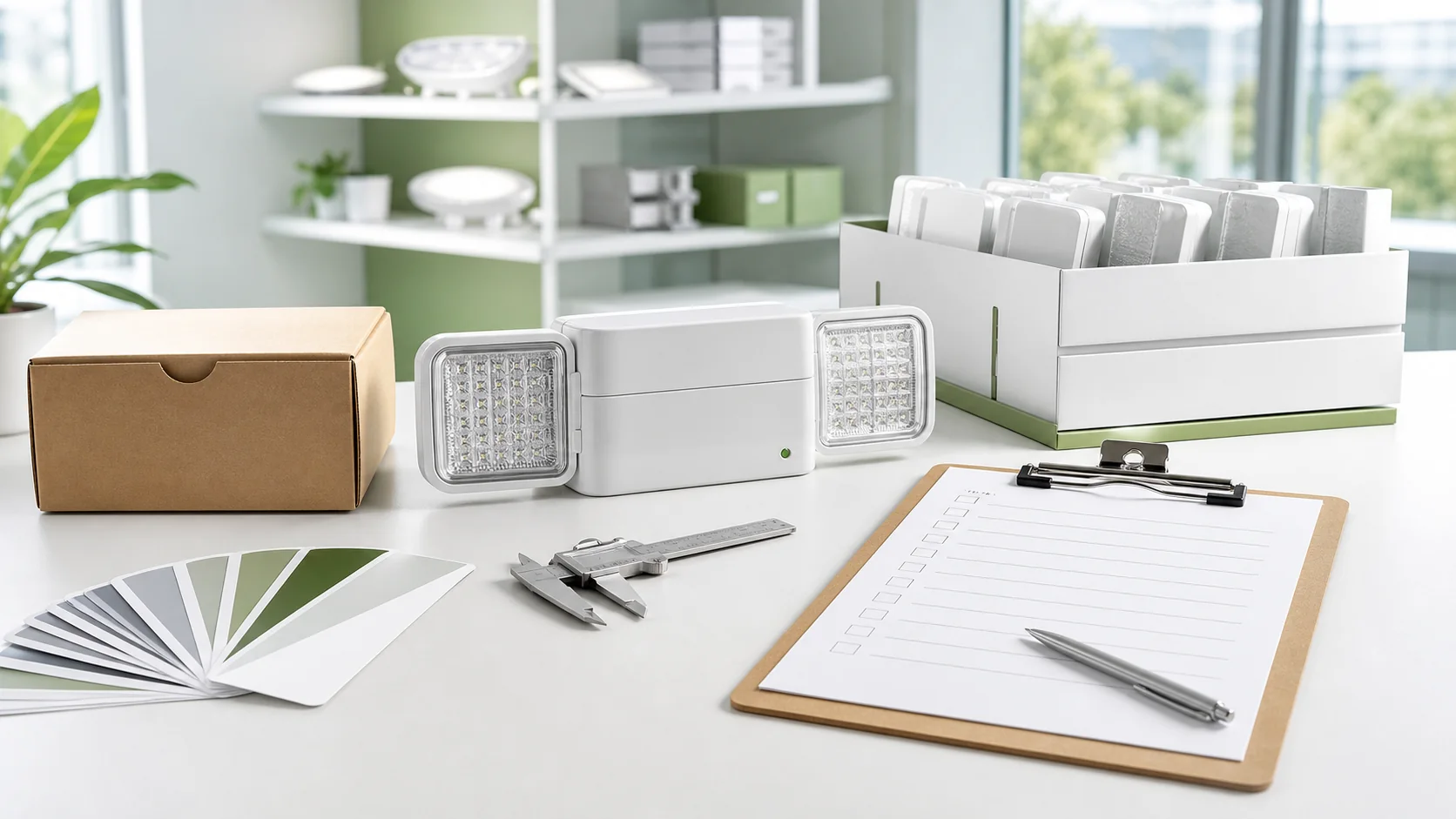
In brief: Approve an emergency-lighting sample against one controlled specification, not a photograph or a successful switch-over alone. Verify product identity, electrical configuration, emergency output and duration, construction, markings, documents, artwork, packaging and change control before authorizing mass production.
The direct answer
An emergency lighting sample should be approved only when the physical unit, its controlled specification and its evidence file describe the same product. Check the exact model and revision, mains input, operating mode, LED and optic, emergency output, battery, rated duration, charging and test functions, construction, labels, instructions, destination documents, artwork and packaging. Record results and permitted tolerances, close every deviation, then identify which later changes require reapproval.
A sample that illuminates after the normal supply is removed has passed one functional observation, not the whole approval. It may still have the wrong battery, emergency output, duration, wiring, legend, mounting interface, document revision or package marking. A photograph cannot prove those items, and a generic certificate cannot prove that the sample is within its model scope.
The approval record should answer three questions:
1. Is this the exact configuration the buyer intends to order? 2. Does the evidence show that it performs the agreed functions under the stated conditions? 3. Can production and inspection compare later units with an unambiguous approved baseline?
Sample approval is a production gate, not a compliance shortcut
Sample approval is the buyer's controlled decision to accept, reject or conditionally accept a defined pre-production configuration. It connects the quotation, specification, bill of materials, drawings, artwork, test results and physical unit before mass production.
It does not replace product certification, a destination-market conformity assessment, project photometric design, installation approval, commissioning or a pre-shipment inspection. Those activities answer different questions. The approved sample becomes a comparison baseline; it does not prove that every production unit will match it.
For that reason, keep this page's intent separate from the next roadmap topics. A factory test plan controls how production is checked. A specification-sheet review verifies what published data means. A product inspection plan defines how a shipment is sampled and accepted. This checklist controls the buyer's decision on the pre-production sample.
Eight approval gates to put on one record
| Approval gate | What to freeze | Evidence or observation | |
|---|---|---|---|
| Product identity | Supplier, model, revision, product category and sample serial or traceability code | Rating label, drawing, bill of materials, dated photographs and sample tag | |
| Project and market basis | Destination, application, required operating mode, duration, environment, mounting and named standards or certification path | Buyer specification, project schedule and compliance-document list | |
| Electrical configuration | Input voltage and frequency, switched and unswitched feeds, driver, LED load, battery, charger, wiring and controls | Data sheet, wiring diagram, component identifiers and functional test record | |
| Emergency performance | Changeover, emergency output or photometric file, rated duration, restoration, recharge information and indicators | Agreed test method, result, conditions, equipment reference and acceptance criterion | |
| Construction and installation | Dimensions, fixings, cable entries, terminals, strain relief, earthing, enclosure, thermal limits and service access | Drawing, dimensional check, visual inspection and applicable test evidence | |
| Marking and documents | Rating label, emergency markings, legend or pictogram, instructions, declarations, reports and destination languages | Controlled artwork, document revision and exact model or family scope | |
| Appearance and packaging | Colour, finish, visible defects, logo, accessories, inner protection, carton, barcode and shipping marks | Approved artwork, packing list, photographs and physical package review | |
| Decision and change control | Pass, fail or conditional status; open actions; permitted tolerances; reapproval triggers; signatories | Dated approval form and a retained reference sample or equivalent controlled record |
Do not let one gate compensate for another. Clean moulding does not excuse an unverified battery. A correct label does not prove emergency output. A test report with no model and revision traceability does not close the configuration check.
Freeze the sample identity before testing
Start by assigning the sample a unique reference. Record the product model, drawing revision, bill-of-material revision, label revision, packaging revision, date received and any serial or batch identifier available. Photograph the rating label, internal component labels, wiring, connectors, battery, indicator, mounting parts, accessories and package.
The controlled configuration should identify the LED board or module, optic, normal and emergency driver, battery pack, charger or control board, test device, firmware or selectable settings when they affect function. Record buyer-approved equivalents explicitly. An unlisted substitution should trigger review rather than being treated as interchangeable.
Use the site's existing guides to define adjacent technical fields without giving this page their search intent. The maintained and non-maintained guide owns operating-mode selection. The international voltage guide owns input and wiring specification. The battery chemistry guide and battery-duration guide own battery, runtime and recharge decisions.
Test the ordered function, not a generic demonstration
Write the test sequence and acceptance criteria before testing. At minimum, the sequence should cover normal energization, charging or ready indication, loss of normal supply, emergency changeover, emergency operation at the approved setting, restoration of the normal supply and the expected indication afterwards. Maintained products also need their normal-lighting behaviour checked. Products with controls, dimming, rest or inhibit functions need the ordered control behaviour demonstrated.
If rated duration is an approval criterion, test the exact sample after the charging and conditioning steps specified for that product. Record the start condition, ambient condition, emergency output method, elapsed time, end condition and any failure indication. Do not approve duration from battery amp-hours or from a unit that merely remained visibly lit. The emergency lumen-output RFQ guide explains why emergency lumens and project photometric evidence must remain tied to the ordered optic and duration.
IEC 60598-2-22:2021 specifies particular requirements for emergency luminaires on emergency power supplies not exceeding 1,000 V. IEC 60598-1:2024 specifies general safety requirements and tests for luminaires. These standard scopes support a disciplined product review, but a standard title in a quotation is not evidence that this sample was tested, certified or accepted for a particular country.
For self-contained emergency controlgear, IEC 61347-2-7:2011+AMD1:2017+AMD2:2021 covers particular safety requirements for battery-supplied electronic controlgear. Component evidence must still connect to the complete ordered luminaire.
Manual test and self-test need separate acceptance criteria
A manual test button should initiate the function stated in the product instructions, and its indicator should behave as documented. For a self-test product, record normal indication, function-test behaviour, duration-test behaviour and the fault states that the ordered product claims to detect. Demonstrate only faults that can be simulated safely and are included in the agreed method.
IEC 62034:2012 specifies basic performance and safety requirements for products and components incorporated into automatic test systems for battery-powered emergency escape lighting. The standard includes functional and duration-test topics. It does not mean that every product marketed as "auto-test" has the same schedule, fault coverage, indication or recording function.
Tridonic's SELFTEST emergency-device functional description documents model-family-specific indicator patterns, battery faults, function tests and duration tests. Use that as an example of the detail a supplier instruction can contain, not as a code table for another product.
Check mechanical, visual and installation details while the unit is open
Measure the dimensions that affect installation: overall size, cut-out, mounting centres, suspension parts, cable entry, terminal space and service clearances. Check housing fit, lens or diffuser seating, seals, fasteners, strain relief, insulation, earthing points, battery restraint, sharp edges and access to the test device and indicator. Compare actual construction with the approved drawing and photographs.
Use the form-factor guide that matches the sample. A wall or bulkhead emergency light needs its permitted orientation, cable entry, enclosure and maintenance access confirmed. A twin-head emergency light needs head adjustment and retention checked against the approved aiming task. A recessed or surface emergency downlight needs ceiling cut-out, void, fixing and service access confirmed. An emergency exit sign needs the exact legend, arrow, face count, viewing direction and mounting arrangement approved. An emergency conversion kit needs the host luminaire, normal driver, LED load, kit, wiring and thermal integration controlled as one system.
The buyer should name the environment rather than infer suitability from appearance. IP, IK, temperature, corrosion, ultraviolet exposure, condensation and mounting-surface conditions are separate evidence questions. Do not assign an unpublished protection rating from a photograph or sample impression.
Match labels, instructions and reports to the physical sample
Compare the product label with the quotation and data sheet: model, input, frequency, operating information, battery or replacement reference when applicable, warnings and destination-required markings. Check label material, position, legibility and artwork revision. For an exit sign, approve the exact pictogram, wording, arrow and any supplementary text against the project sign schedule.
Review the installation, operation, testing, maintenance and battery-replacement instructions. Wiring diagrams should match the terminals, colours and ordered operating mode. Document languages and responsible-party details are destination decisions, not universal defaults.
Every declaration, certificate or report supplied for approval should identify its issuing organization, document number, model or family scope, standard and edition where applicable, date and current status. Verify that the sample belongs within that scope. For North American projects, UL Solutions describes UL 924 as a standard for emergency lighting and power equipment with requirements beyond general lighting certification. That is a regional pathway; it is not a worldwide approval and should not be transferred to an unlisted model.
Approve artwork and packaging as controlled product inputs
Packaging approval is not only a cosmetic review. Confirm the product model, quantity per carton, accessories, installation hardware, instructions, spare parts, barcode, destination marks, handling marks and inner protection. Check that cables, signs, lenses, batteries and brackets cannot move into damaging contact during normal handling.
Approve logo, label, manual, carton and barcode revisions together. If the sample uses temporary artwork, mark the approval conditional and name the final file that must replace it. Do not sign a physical sample while leaving the commercial artwork undefined.
The Signify checklist for converting an existing emergency luminaire with an LED tube records project and product identity, environmental and visual checks, wiring, emergency switching, indication, monitoring and inspector/reviewer signatures. Its application is specific, but its record structure illustrates why an auditable checklist is stronger than an informal email saying "sample approved."
Use pass, fail and conditional approval deliberately
Approve the sample only when all mandatory evidence and physical checks pass. Reject it when a required feature, configuration, safety boundary or document scope is wrong. Use conditional approval only for limited, named actions that do not conceal a material technical uncertainty.
A useful decision record includes:
- sample identifier and every controlled revision;
- each acceptance criterion, result and evidence reference;
- nonconformities, owner, corrective action and closure evidence;
- permitted production tolerances and approved equivalents;
- changes that require a new sample or document review;
- approval status, date and named buyer and supplier signatories;
- location of the retained reference sample or digital approval file.
The "golden sample" is useful only when its identity and limits are documented. Colour, finish and assembly can be compared physically, while electrical performance and compliance scope still require records and tests. Define how long the sample will be retained and what happens if a component becomes unavailable.
Category-specific sample focus
| Product type | Extra approval focus | |
|---|---|---|
| Wall or bulkhead light | Orientation, cable entry, enclosure, diffuser, mounting and maintenance access | |
| Twin-head light | Head travel, aiming retention, mounting strength and photometric identity for each optic | |
| Downlight | Recessed or surface construction, cut-out, ceiling fit, void, bezel and service access | |
| Exit sign | Legend, arrow, face count, viewing direction, suspension or wall hardware and visual uniformity | |
| Conversion kit | Host luminaire, driver and LED compatibility, wiring, enclosure fit, thermal condition and finished-luminaire evidence |
Review representative current catalog records for L103N wall/bulkhead light, L107N-20W twin-head light, L124N-R recessed downlight, L217M-B suspended exit sign and F355MN conversion kit. Their published fields help identify questions; they do not supply unpublished test results or universal approval.
Emergency lighting sample approval form
- Project, destination and buyer reference: [details]
- Supplier, model, sample ID and date received: [details]
- Quotation, specification, drawing and bill-of-material revisions: [files]
- Operating mode, input, frequency and wiring: [approved configuration]
- LED, optic, normal driver and emergency driver: [identifiers]
- Battery chemistry, pack model, connector and replacement reference: [details]
- Emergency output, photometric file and rated duration: [criteria and results]
- Charging, changeover, restoration, indicator and test functions: [criteria and results]
- Dimensions, mounting, cable entry, enclosure and service access: [criteria and results]
- Labels, instructions, reports and certification scope: [document list]
- Logo, colour, carton, barcode, accessories and shipping marks: [artwork revisions]
- Nonconformities and corrective actions: [open / closed]
- Approved equivalents, tolerances and reapproval triggers: [controlled list]
- Status: [approved / rejected / conditionally approved]
- Buyer and supplier signatories, dates and retained-record location: [details]
How Zhuiming supports sample approval
Hangzhou Dreamy Technology Co., Ltd. publishes a sample-to-production workflow and model-level emergency-lighting catalog. The company's OEM and ODM process says mass production begins after the customer confirms the sample and order details. Its factory and quality page also states that testing scope is matched to the product and project and that customer or third-party inspections can be arranged.
Those are company-confirmed process capabilities, not proof that every requested configuration, test, certificate or acceptance criterion is available for every model. The quotation and approval plan must define the exact scope.
Send the target market, product model, quantity, technical specification, artwork list, required evidence and sample-approval checklist for technical and commercial review.
Sources and scope
- IEC: IEC 60598-1:2024, general requirements and tests for luminaires
- IEC: IEC 60598-2-22:2021, particular requirements for emergency luminaires
- IEC: IEC 61347-2-7:2011+AMD1:2017+AMD2:2021, battery-supplied emergency controlgear
- IEC: IEC 62034:2012, automatic test systems for battery-powered emergency escape lighting
- UL Solutions: emergency lighting testing and certification, including North American UL 924 context
- Signify: checklist for converting an existing emergency luminaire with an LED tube
- Tridonic: SELFTEST emergency-device functional description
- Eaton: Fundamentals of emergency lighting, testing and battery-system context
Sources reviewed 5 August 2026. This article separates verified standard scopes, regional certification context, manufacturer-specific examples, Zhuiming's published capabilities and editorial procurement recommendations. It is not a certificate, laboratory report, project lighting design, installation instruction, shipment inspection plan or statement of worldwide compliance.
Frequently asked questions
What should an emergency lighting sample approval check?
Check the exact model and revision, electrical configuration, operating mode, LED and optic, battery, emergency output, rated duration, charging, changeover, test functions, construction, labels, documents, artwork, packaging, deviations and change-control rules against one controlled specification.
Is a working emergency light sample enough for approval?
No. A successful switch to battery power proves only one observation. Approval also needs configuration identity, emergency output and duration evidence, construction, markings, document scope, packaging and a record of what production must reproduce.
Should the sample complete a full emergency-duration test?
Complete the rated-duration test when duration is an approval criterion, using the charging, conditioning, ambient, output and measurement conditions agreed for the exact product. Visible illumination alone does not prove the required output throughout the period.
Does an approved sample prove that the shipment will match?
No. The approved sample is a controlled baseline for production and inspection. The purchase specification, process controls, change notification, pre-shipment checks and agreed sampling plan are still needed to evaluate shipment conformity.
Who should sign an emergency lighting sample approval?
The supplier and the buyer's authorized technical or quality representative should sign the controlled record. Project designers, importers, laboratories, certification bodies or authorities may also need to approve items within their responsibility, depending on the destination and project.