In brief: Approve an emergency conversion kit as part of one complete luminaire system. Match the normal driver, LED load, emergency driver, battery, wiring, enclosure and thermal conditions, then verify emergency output, duration and destination-market evidence on the finished configuration.
The direct answer
Do not buy an emergency conversion kit from mains voltage, battery capacity or a broad lamp-wattage claim alone. Approve the normal LED driver, LED module, emergency driver, battery, wiring, indicator or test device, luminaire enclosure and installation conditions as one identified configuration. Then verify emergency-mode output, rated duration, charging, changeover, temperature and the destination-market evidence required for the finished luminaire.
A conversion kit adds emergency operation to a compatible host luminaire; it does not make every luminaire compatible or automatically compliant. Electrical matching, available space, heat, insulation, cable routing, controls, optics and access can all change the result. Field conversion may also follow a different approval path from factory integration, so the buyer must state where and by whom the conversion will be completed.
The practical approval record connects four items: the host luminaire and normal driver, the exact LED load, the complete emergency-kit bill of materials, and test evidence from the finished configuration. If any one of those changes, the responsible engineer should decide whether compatibility testing and approval must be repeated.
What is an emergency conversion kit?
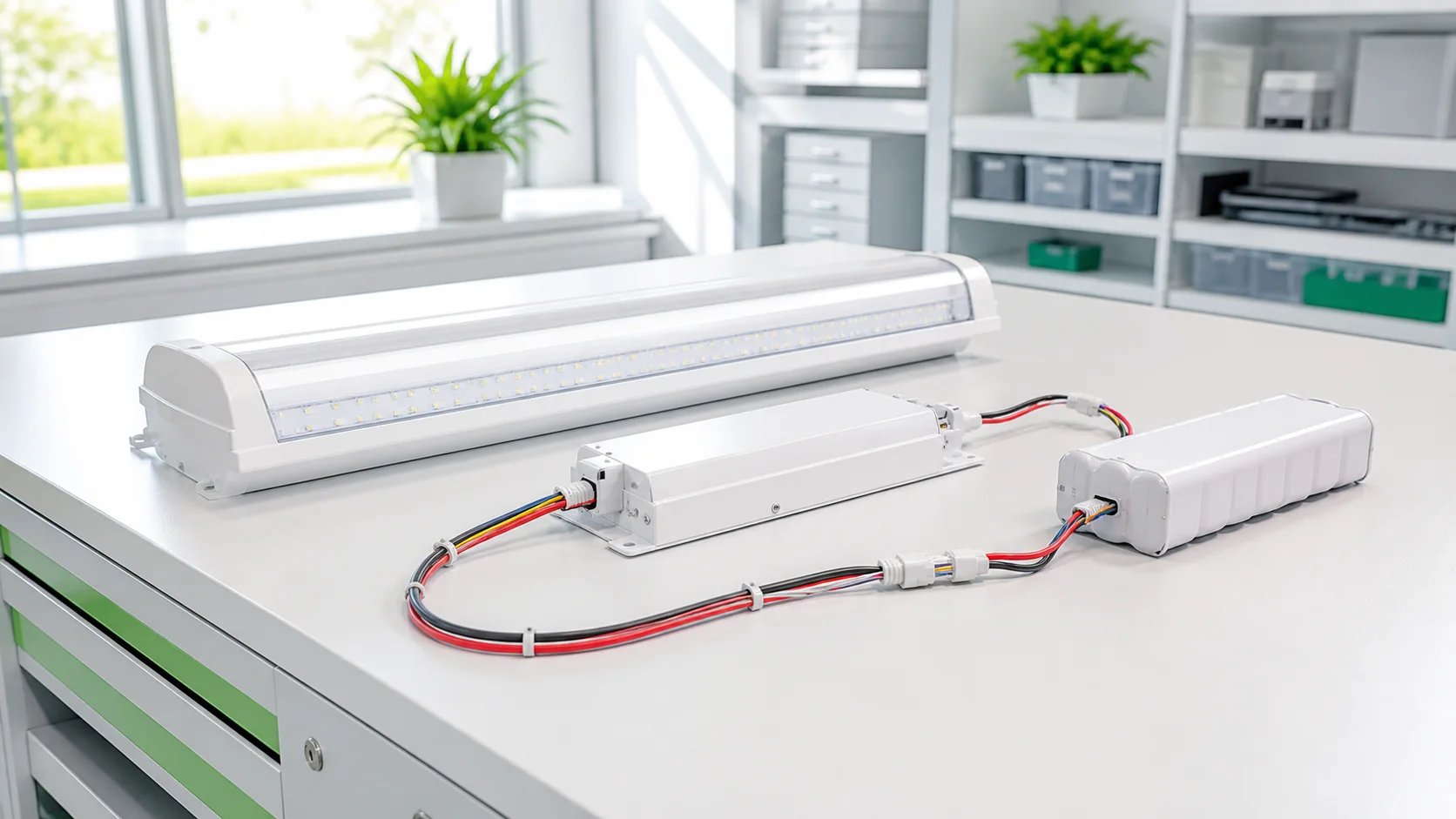
An LED emergency conversion kit is a set of components used to add battery-backed emergency operation to a compatible general-lighting luminaire. Depending on the design, the emergency driver may operate the existing LED module at a reduced output or power a separate emergency LED module. The kit can include an emergency control unit, battery, wiring harness, charge indicator, test switch, temperature sensor or mounting accessories.
Tridonic describes an integrated arrangement in which an EM converterLED and battery supplement the normal LED driver. Fulham also publishes a different architecture in which a kit includes an emergency driver, battery and separate LED module. These are established-manufacturer examples, not interchangeable wiring templates. Follow the exact supplier instructions for the ordered system.
An emergency conversion kit is not the same as a central-battery luminaire, a complete self-contained emergency luminaire or an ordinary replacement driver. It also does not determine where emergency lighting is required. The project designer remains responsible for the emergency-lighting layout, while the luminaire manufacturer or approved converter is responsible for the converted product within the agreed approval scope.
Compatibility has seven separate checks
| Compatibility check | Information the buyer should provide | Evidence to approve | |
|---|---|---|---|
| Mains and control | Nominal voltage or range, frequency, switched and unswitched supply, dimming or control protocol | Exact input rating, wiring diagram, control behaviour and changeover test | |
| Normal LED driver | Manufacturer, model, output type, voltage and current limits, dimming method | Supplier compatibility statement or design-in record for the exact driver | |
| LED load | Module model, series/parallel arrangement, forward-voltage range, normal current and maximum permitted input | Emergency-driver operating range and a tested LED-load configuration | |
| Emergency output | Required emergency watts or lumens, optic and project photometric need | Measured output and model-specific photometric evidence under emergency operation | |
| Battery and duration | Chemistry, pack model, voltage, capacity, temperature limits and required duration | Approved driver-battery combination, full-duration result, charging and replacement data | |
| Mechanical and thermal fit | Enclosure space, fixing, cable routes, insulation class, component temperatures and maintenance access | Drawing, installation limits, temperature checks and finished-sample inspection | |
| Test and approval route | Manual test, self-test or monitored system; factory or field conversion; destination evidence | Functional record, indicator/fault behaviour, labels, instructions and required report or certification scope |
Passing one row does not prove the others. A kit may accept the project's mains supply yet fall outside the LED module's operating range. It may operate the LED safely but fail to provide the required emergency output. It may pass a bench test but overheat, interfere with controls or become inaccessible after installation in the host enclosure.
Match the normal driver and LED load
Start with an electrical schedule for the exact host luminaire. Record the normal driver's output type and limits, the LED module's forward-voltage range and current, the number and arrangement of modules, and any dimming or control interface. Do not rely on normal lamp wattage as a compatibility shortcut.
Two emergency-kit architectures need different questions. A shared-load design switches the existing LED module from its normal driver to emergency operation, so switching, isolation, LED voltage and current limits must be compatible. A separate-light-source design adds its own emergency LED module, which can reduce dependence on the normal driver but creates new mechanical, optical and thermal interfaces.
The Signify TrustSight design-in guide publishes connection, insulation, battery and installation conditions for its own driver family. Tridonic publishes exact forward-voltage ranges, lead-length limits and approved battery combinations in its EM converterLED technical data. These documents show the level of detail a buyer should request. Their limits must not be transferred to another brand or model.
For export projects, define mains input, frequency, charger and labels with the emergency-lighting voltage guide. Voltage coverage at the kit input does not prove compatibility at the emergency output.
Emergency output must be measured on the finished configuration
Normal-mode lumens, lamp watts and battery amp-hours do not establish emergency lighting performance. The emergency driver may operate the LED at a reduced current or constant power, and the optic, temperature, battery state and conversion method affect the usable result.
Ask for emergency luminous flux and suitable photometric evidence for the converted luminaire at the ordered setting and duration. The project designer should use that evidence with the mounting layout and adopted requirements. Fulham's published compatibility and suitability guidance makes the same boundary explicit for its products: electrical compatibility and predictable emergency output do not by themselves establish an as-installed compliant escape route.
Use the emergency light lumen-output RFQ guide for the photometric evidence fields. Use the battery-duration guide to keep required runtime, output and recharge conditions together. A three-hour label without the output sustained for that period is incomplete procurement evidence.
Battery, charging and temperature are one subsystem
Approve the battery only in the combination specified for the emergency driver. Chemistry, cell count, pack voltage, connector, protection, temperature sensing, charging method, discharge cut-off and firmware or self-test logic can all be configuration-specific.
IEC 61347-2-7:2011+AMD1:2017+AMD2:2021 specifies particular safety requirements for battery-supplied electronic controlgear for self-contained emergency lighting. IEC 60598-2-22:2021 specifies particular requirements for emergency luminaires and introduced new requirements for lithium batteries in its fifth edition. These are product-standard references; citing them does not prove that a particular driver, battery and converted luminaire has been tested or accepted for a destination market.
If the battery chemistry or pack changes, reopen the compatibility record rather than treating similar voltage or amp-hours as equivalence. The Ni-Cd vs Li-ion emergency-light battery guide covers chemistry, storage, transport and replacement boundaries without duplicating the kit-selection task here.
Mechanical integration is part of safety and performance
Confirm where every component will be fixed, the minimum clearances, wiring paths, maximum lead lengths, cable ratings, strain relief, insulation and earthing arrangement. Record the ambient range and maximum permitted case or battery temperature at the actual locations inside the luminaire. A component that fits physically may still be too close to the LED driver, light source, insulation, diffuser or service opening.
The status indicator and test device should remain visible or accessible as required by the product instructions and project maintenance plan. The battery must be replaceable through an approved service route. Added parts must not defeat the host luminaire's enclosure, fire, acoustic, ingress, impact or mounting conditions.
For ceiling-integrated products, the emergency downlight selection guide covers cut-out, void and service access. If conversion is being considered only to avoid choosing a purpose-built emergency form factor, compare the host with the emergency wall light guide and twin-head emergency light guide before committing to integration.
Factory integration and field retrofit are not the same approval
State whether the emergency kit will be installed during luminaire manufacture, by an authorized converter or on site. The responsible party, permitted instructions, labels, production controls and certification route can differ by market and product.
For North American projects, do not assume a component recognition or a general product claim permits field installation in every host luminaire. UL Solutions describes UL 924 as covering emergency lighting and power equipment, while Fulham publishes specific kits as UL Classified for stated factory or field installation pathways. Confirm the exact kit, host, installation instructions, marking and authority requirements.
For IEC or EN projects, similarly do not turn an emergency-controlgear declaration into automatic approval of the converted luminaire. The complete product still needs the applicable assessment, documentation and installation review. Destination-market legal and certification decisions belong to the importer, project team and responsible conformity specialist.
Manual test, self-test and monitoring must be specified
Choose the test function from the project maintenance strategy, not from the word "auto-test" alone. Define what is tested, how a fault is indicated, how results are recorded, how a test is initiated or scheduled, and what commissioning and maintenance instructions are required.
IEC 62034:2012 specifies basic performance and safety requirements for products and components incorporated into automatic test systems for battery-powered emergency escape lighting. It covers automatic-test-system functions; it does not make every product with an indicator an IEC 62034 system. Request exact-model evidence and a functional demonstration for the ordered configuration.
Keep operating mode separate. A kit can be maintained, non-maintained or configured for more than one mode, but the approved wiring and normal-lighting function decide the result. The maintained vs non-maintained guide explains that project choice. An exit sign also needs its own legend, sightline and mounting approval; adding a conversion kit does not resolve those sign decisions.
Compare Zhuiming conversion kits by published catalog fields
Zhuiming's current catalog lists three Emergency Conversion Kit records. The table repeats only published fields and does not claim universal compatibility, certification, emergency lumens, temperature limits, ingress protection for a finished luminaire or suitability for field retrofit.
| Model | Published operation | Published input | Published load description | Published battery | Published duration | Published installation | |
|---|---|---|---|---|---|---|---|
| F355MN | Maintained / non-maintained, auto-test | AC 110–240 V, 50/60 Hz | For 1–10 W LED lamps; customizable up to 45 W | Li-ion 14.8 V / 2.25 Ah | More than 3 hours; 1–3 hours customizable | Inside compatible luminaire | |
| L360N | Non-maintained, auto-test | AC 110–240 V, 50/60 Hz | For LED lamps with external electronic driver | Li-ion 7.4 V / 2.2 Ah | More than 3 hours | Inside compatible luminaire | |
| L360N-A3 | Non-maintained | AC 110–240 V, 50/60 Hz | For LED lamps with external electronic driver | Li-ion 7.4 V / 2.2 Ah | More than 3 hours | Inside compatible luminaire |
Open the catalog records for F355MN, L360N and L360N-A3 before making a shortlist. Their published load descriptions are screening information, not proof that an unnamed host driver, LED module and enclosure are approved.
Emergency conversion kit RFQ block
- Destination country, project type and required standards or certification path: [details]
- Factory integration, authorized conversion or field retrofit: [responsible party]
- Host luminaire, normal driver and LED module identifiers: [manufacturer and model]
- LED electrical arrangement, forward-voltage range and normal current: [values]
- Mains input, frequency, switched/unswitched supply and control system: [values and diagram]
- Maintained, non-maintained or switchable operation: [required mode]
- Required emergency output and photometric evidence: [lumens / file / report]
- Rated duration and recharge condition: [time and acceptance]
- Battery chemistry, pack model, connector, temperature and replacement part: [details]
- Available space, fixings, lead lengths, insulation, case-temperature and access limits: [drawing]
- Manual test, self-test or monitoring functions and indication: [requirements]
- Labels, instructions, reports, sample tests and change-control rules: [approval package]
- Quantity, logo, packaging and commercial customization: [scope]
Sample-approval checklist
1. Match the host luminaire, normal driver, LED module and every kit component to the controlled bill of materials. 2. Check dimensions, fixings, wire routing, strain relief, insulation, earthing, indicator, test device and battery access against the approved drawing. 3. Confirm normal operation, control or dimming behaviour and correct changeover after loss of the normal supply. 4. Measure emergency output using the agreed method and connect the result to the approved optic and photometric file. 5. Run the rated-duration and recharge checks under the stated conditions; record battery and temperature data. 6. Demonstrate manual test, self-test or monitoring behaviour, including indicators and simulated fault responses that are in scope. 7. Inspect component and battery temperatures at the defined locations and verify the supplier's limits. 8. Review labels, wiring diagram, installation instructions, replacement parts, reports and destination-language documents. 9. Record which changes require reapproval, including driver, LED, battery, firmware, wiring, enclosure, optic or supplier substitutions. 10. Have the responsible project and compliance parties accept the finished configuration before mass production or site conversion.
How Zhuiming supports a conversion-kit project
Hangzhou Dreamy Technology Co., Ltd. publishes three emergency conversion kit records and can review voltage, battery, duration, operating mode, LED power, wiring, labels, instructions and packaging through its OEM and ODM process.
That is a company-confirmed review and customization scope, not a claim that every host luminaire, driver, LED load, output target, certification or retrofit path is feasible. Final compatibility and evidence depend on the exact configuration, destination requirements, integration responsibility and approved sample.
Send the host-luminaire data sheet, driver and LED identifiers, wiring diagram, available space, target output, duration, quantity and required approval evidence for technical and commercial review.
Sources and scope
- IEC: IEC 61347-2-7:2011+AMD1:2017+AMD2:2021, battery-supplied emergency controlgear
- IEC: IEC 60598-2-22:2021, particular requirements for emergency luminaires
- IEC: IEC 62034:2012, automatic test systems for battery-powered emergency escape lighting
- Signify: TrustSight emergency driver design-in guide
- Tridonic: integrated emergency-lighting system overview
- Tridonic: EM converterLED technical data
- LEDVANCE: emergency conversion kit product family
- Fulham: FHSCP-UNV compatibility and suitability guidance
- Fulham: HotSpot1 LED emergency lighting kits
- UL Solutions: emergency lighting testing and certification
Sources reviewed 4 August 2026. This article separates verified standard scopes and manufacturer examples from Zhuiming's published catalog fields and editorial recommendations. It is procurement guidance, not a product engineering approval, project lighting design, installation instruction, certification decision or statement of worldwide compliance.
Frequently asked questions
How do I choose an emergency conversion kit for an LED luminaire?
Match the exact normal driver, LED module, emergency driver, battery, wiring, enclosure and thermal conditions. Then approve emergency output, duration, charging, changeover, test function and destination-market evidence on the finished configuration.
Can one emergency conversion kit work with any LED driver?
No. A broad mains or lamp-wattage range does not prove compatibility. Check the normal driver's output type and limits, the LED load's voltage and current, switching method, controls, wiring and the emergency driver's documented operating range.
Does an emergency conversion kit make a luminaire compliant?
Not automatically. Component compliance or compatibility does not by itself approve the finished converted luminaire or the installed emergency-lighting design. Confirm the exact product, integration route, destination requirements, evidence and responsible approval parties.
What should an emergency conversion kit sample test?
Verify the controlled bill of materials, mechanical and thermal integration, normal operation, changeover, emergency output, rated duration, recharge, indicators or self-test, labels, instructions, replacement parts and destination evidence.
Can an emergency conversion kit be installed on site?
Only when the exact product instructions, host-luminaire conditions and destination approval path permit it. Factory integration, authorized conversion and field retrofit can have different responsibilities, markings, tests and certification requirements.